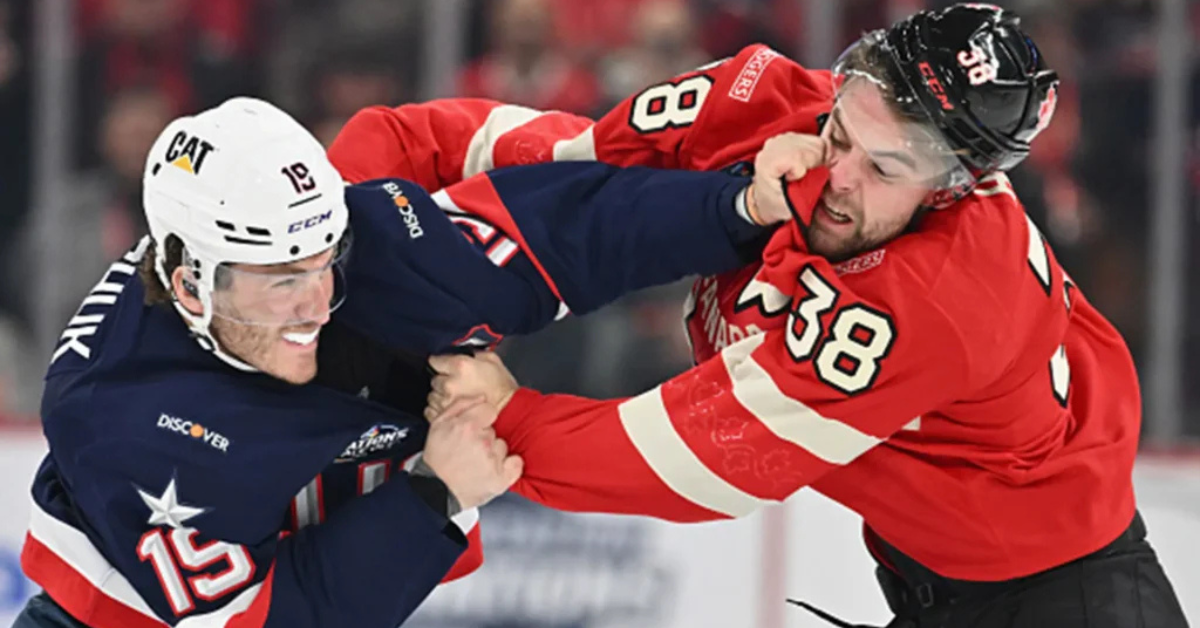
Hockey is the only major team sport where two athletes can square up, trade punches, sit for five, and then get a shift change. Since the early 1920s the NHL has chosen to regulate hockey fights rather than erase it, writing “fisticuffs” into the rulebook instead of pretending it doesn’t happen. With it comes an unwritten code that players treat almost like a martial art on ice. Let’s break down the martial arts of hockey fights.
Hockey fights exist for a reason, and usually several at once. The most common trigger isretaliation, someone takes a cheap shot at a team’s skilled player, and anenforcersteps in to settle the account. Fights also serve as momentum swings, a way to fire up a bench and a building when the scoreboard isn’t cooperating. Intimidation plays a role too. Gordie Howe famously broke Lou Fontinato’s nose in a fight in the late 1950s and got a lot more room on the ice for the rest of his career because of it.Wayne Gretzkyhad Dave Semenko and Marty McSorley keeping the wolves away. Brett Hull had Kelly Chase. The enforcer’s job, unofficial as it is on the roster, has always been a form of on-ice insurance.
Defenders of fighting also argue it works as a pressure valve. Games can get dangerously chippy, and a scrap between two willing participants lets the steam out so the rest of the game stays safer for everyone. It is, in hockey terms, policing from within.
There is an entire etiquette to hockey fighting that never appears in the rulebook. Two players have to agree to it, usually through a nod, a few words, or squaring up face to face, before it kicks off. This mutual consent helps both avoid the instigator penalty and keeps unwilling participants out of harm’s way. Enforcers typically fight other enforcers. If a rival declines because he’s banged up, that gets respected, winning against an injured opponent is considered an empty victory. Fighters are also divided informally into “heavyweights” and “light heavyweights,” with the understanding that crossing weight classes can end careers.
The ritual starts with dropping the sticks, which is mandatory, using one as a weapon earns an automatic ejection and suspension. The gloves come off next because the hard leather and plastic would turn every punch into something far more damaging. Fighting bare-knuckled is the standard.
Helmets are where it gets interesting.Playersused to remove their own helmets before fights because punching a hard shell hurts the hands. Since the 2013–14 season, however, the NHL introduced a rule assessing a minor penalty to any player who removes his helmet before engaging in a fight. The rule came partly in response to George Parros slamming his head on the ice during a bout, and the league’s growing concern over head injuries. Some players have found creative workarounds, there have been instances where two fighters gently removed each other’s helmets to avoid the extra two minutes and then started swinging. For the most part, though, helmets stay on now.
Then there’s the jersey. Pulling an opponent’s sweater over his head immobilizes his arms and leaves him defenseless, which is why the NHL mandated fight straps, tie-down straps that keep jerseys secured to the pants. The rule exists largely because of Buffalo Sabres enforcer Rob Ray, who routinely stripped off his own jersey before fights so opponents had nothing to grab. With no jersey to grip, the other guy couldn’t control distance or land anything meaningful. The “Rob Ray Rule” forced all NHL jerseys to include the strap, and a player whose jersey comes undone because it isn’t properly secured can be ejected.
A post shared by Timothy Wheaton MMA (@timwheatonmma)
When a player goes down, the fight is done. Linesmen, not referees, are responsible for breaking up fights, and they typically allow a bout to play out until one or both players fall, or until one fighter has gained a dangerous advantage. They approach from the sides, never from behind, wrap arms over the combatants, and push downward to separate them. The referees, meanwhile, stand back and watch for additional infractions, third men jumping in, equipment violations, or anything else that warrants extra penalties.
Both fighters receive a five-minute major penalty and head to the box. Additional penalties can stack on top. An instigator gets an extra two-minute minor and a ten-minute misconduct. An aggressor could earn a game misconduct on top of the five minutes. Three fighting majors in one game means automatic ejection, suspension, and a fine. The league also cracks down on fights in the final five minutes of the third period or overtime, an instigator there draws an ejection, a fine, and a suspension, plus the coach gets fined $10,000.
Source: LowKickMMA.com
