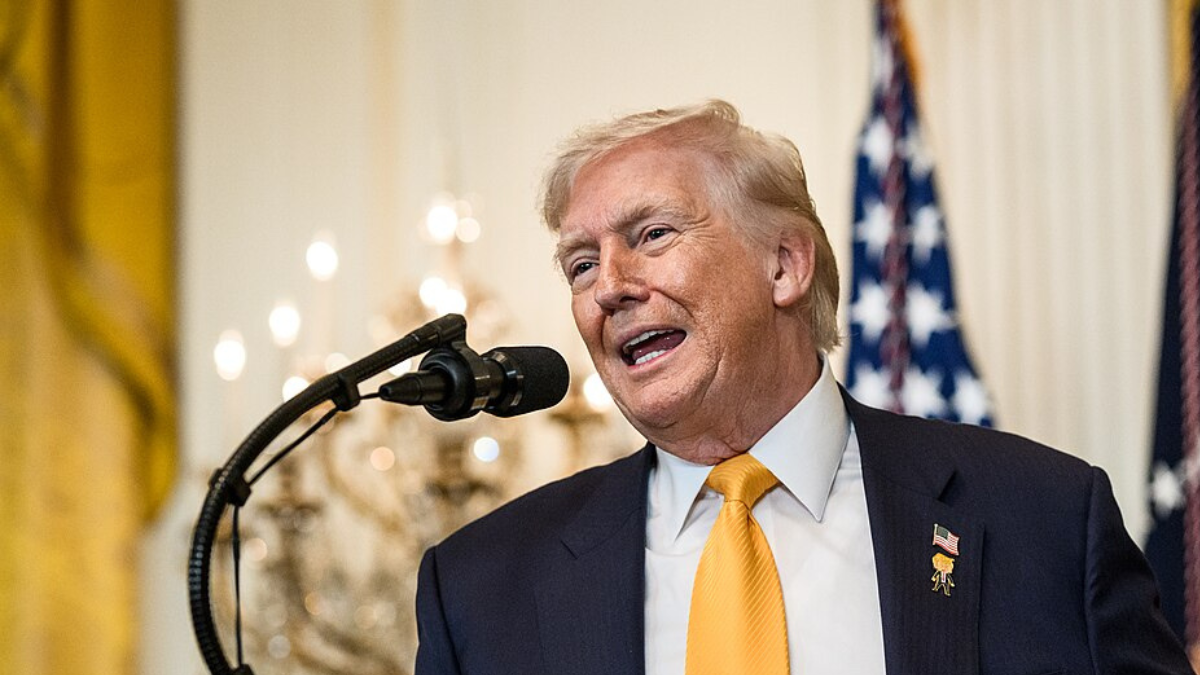
When a man identifying himself as'John Barron'rang in to C-SPAN on 21 February 2026 to rage against the Supreme Court's tariff ruling, he did so using a name that carries more than four decades of documented baggage.
The 32-second call, broadcast live on C-SPAN's Washington Journal, sent social media into a frenzy over the weekend. The caller, described on-air as a Republican from Virginia, sounded remarkably similar to President Donald Trump.
He declared the court's 6-3 ruling against the administration's tariff programme 'the worst decision you ever have in your life, practically', called House Minority Leader Hakeem Jeffries 'a dope', and suggested Senate Minority Leader Chuck Schumer 'can't cook a cheeseburger'. Host Greta Brawner cut him off after about 30 seconds.
The name 'John Barron' first appeared in print on 7 May 1980, in a media report describing a 'John Barron, vice president of the Trump Organisation', who floated the idea of a $1 billion deal to buy the World Trade Centre.
One month later, aNew York Times articlequoted 'John Baron [sic], a vice president of the Trump Organisation', defending Trump's decision to demolish two valuable Art Deco sculptures on the Bonwit Teller flagship store, pieces he had conditionally promised to the Metropolitan Museum of Art.
Barbara Res, a former vice president at the Trump Organisation who worked alongside him throughout that period, offered an explanation to PBS Frontline in 2016. 'I don't think Donald was necessarily evasive with the press when he used his alter ego John Barron,' shetold the programme. 'I think it gave him the opportunity to say things that he couldn't say as Donald Trump.'
The name resurfaced repeatedly across the decade. In 1983, 'Barron' told reporters Trump had passed on purchasing the Cleveland Indians baseball team. In May 1984, 'Barron' put a positive spin on the collapse of a plan to build Trump Castle in New York, telling New York magazine: 'It sure is easier to get a large commission on a $105 million sale than to put up a building.'
Some New York editors recalled that calls from Barron grew so routine they became arunning joke on the city desk, according to The Seattle Times's 2016 reporting. The Washington Post has described the alias as Trump's 'go-to' when 'he was under scrutiny, in need of a tough front man or otherwise wanting to convey a message without attaching his own name to it.'
The most consequential documented use of the 'John Barron' identity came in May 1984, when reporter Jonathan Greenberg was compiling that year's Forbes 400 list of America's wealthiest people. Greenberg, who recorded the call and preserved the tape,published his account in The Washington Post in April 2018, alongside audio of the exchange.
'Barron' told Greenberg that Trump had taken control of his father Fred Trump's real estate portfolio, claiming Trump held 'in excess of 90 percent' of those assets, and that Forbes should list him as a billionaire rather than a mere millionaire.
Source: International Business Times UK
