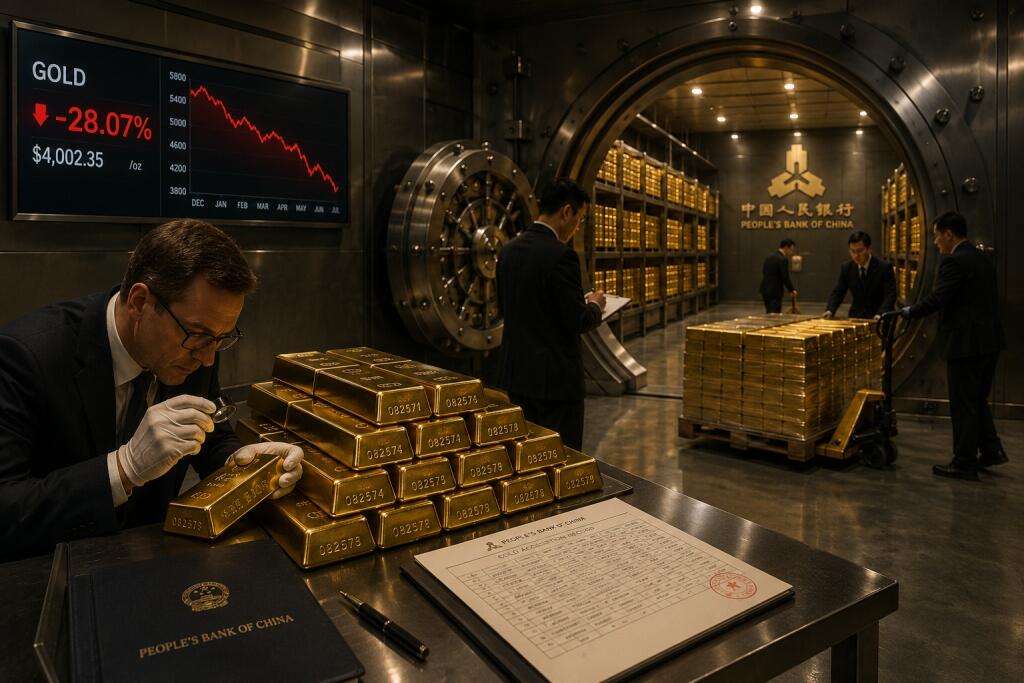
On July 7, Bloomberg published an article with the headline: “Gold’s Bull Market Has Ended and Now All Eyes Are on Bears,” explaining how many retail investors have headed for the exits.
That same day, the People’s Bank of China, the country’s central bank, reported its largest monthly gold purchase since 2023.
Of course, June marked its twentieth consecutive month of adding gold to its reserves. Central banks are relatively price insensitive. They buy gold as a long term hedge to preserve value, not to trade back for more paper.
But they aren’t stupid either, and this shows they are buying the dip.
Gold peaked at $5,589 per ounce on January 28 and trades around $4,000 today, roughly 28% below the high. The second quarter was gold’s worst since 2013. Investors have pulled about $18 billion out of gold ETFs since the peak, much of it late money that piled in during last year’s frenzy and bolted the moment momentum broke.
But the price is not the story. The story is what central banks are doing.
Central banks have been the dominant force in gold since 2022, when Russia invaded Ukraine, the US froze $300 billion of Russia’s central bank reserves, and every finance ministry on earth learned that dollar assets were not the safe havens they’d believed.
In 2024, central banks bought 1,090 tons of gold, close to an all-time record.
That massive demand made gold expensive. The price nearly doubled from its 2025 low, and central bank buying slowed to 863 tons. T