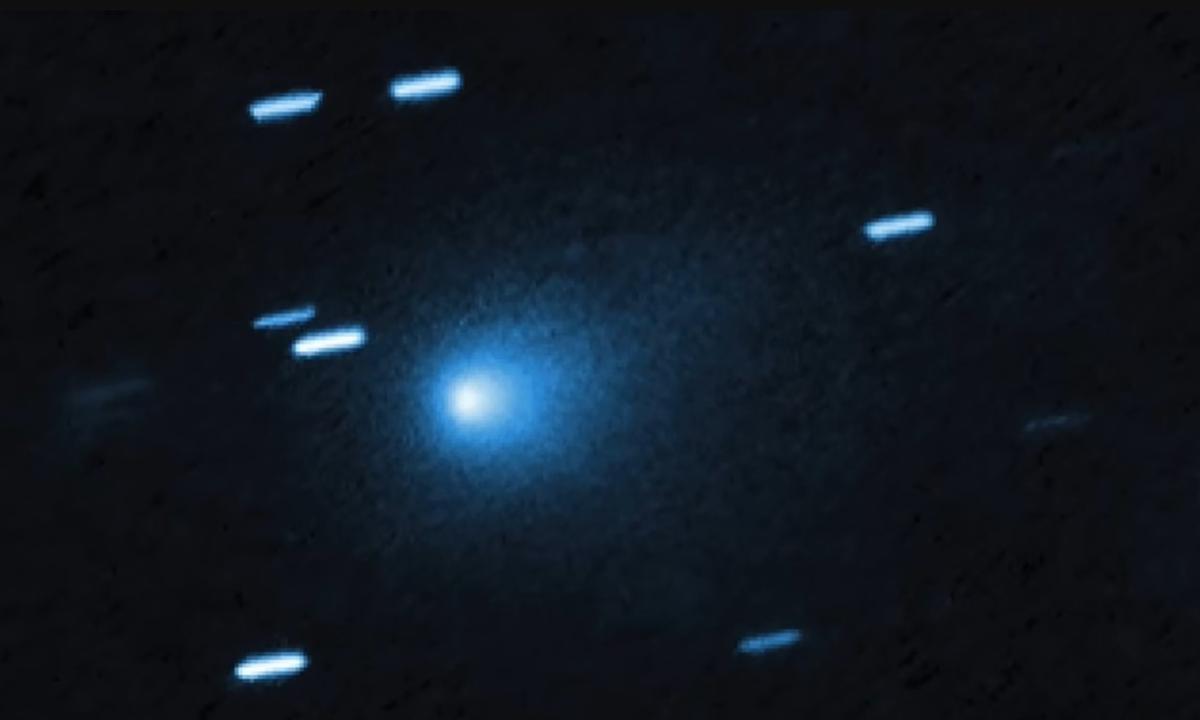
The picture is almost absurd: a probe falling toward the sun, diving into the corona, then lighting solid-rocket boosters at its closest approach on purpose. It is the kind of mission profile that sounds like a dare until you notice the math underneath it, and the name of the prize: 3I/ATLAS, theinterstellar cometalready fleeing our neighborhood.
Here is the gist, without the hand-waving: researchers argue a launch in 2035 could still catch 3I/ATLAS by 2085, roughly 732 astronomical units from the sun about 68 billion miles (109 billion kilometers) from our star, or 732 times Earth's distance. Voyager 1, after a comparable stretch of flight time, sits around 170 AU, which is a useful reminder of how brutally large the outer solar system really is.
The engine trick at the heart of this plan is the Oberth effect, a staple of spaceflight that reaches extreme levels when performed near the sun. It is named after Hermann Oberth, an Austro–Hungarian rocket scientist who later became a naturalised German and worked for the Nazis; he outlined the concept in 1929 in his bookWege zur Raumschiffahrt.
In simple terms, a spacecraft falls deep into a gravity well, gains speed, and then fires its engines at periapsis (closest approach), so that the same propellant produces a greater change in velocity (delta‑V) than it would elsewhere. T. Marshall Eubanks, a former NASA scientist now chief scientist at Space Initiatives Inc. and coauthor of the new paper, told Space: 'Pretty much every launch uses the Oberth effect... however, I cannot find a record of a straight-out Oberth manoeuvre of the type we propose, which is a major rocket burn at closest approach in a flyby.'
The sun is the ultimate gravity well, but it is not a forgiving venue. To achieve at least 5.1 miles per second (8.4 kilometres per second) of delta‑V, the plan calls for a solar Oberth manoeuvre at 3.2 solar radii from the Sun's centre, with the Sun's radius given as 432,450 miles (696,000 kilometres), equivalent to roughly 0.015 AU from the sun.
NASA's Parker Solar Probe showed this neighborhood is not purely theoretical, reaching 0.04 AU on its closest approach in 2023, and enduring temperatures of 2,500–2,600°F (1,370–1,400°C). Adam Hibberd the lead author, an Initiative for Interstellar Studies member, and the creator of Optimum Interplanetary Trajectory Software points to a 2015 Keck Institute design study that used a carbon-composite heat shield (Parker-style) with added aerogel layers for extra insulation. 'In principle, a similar heat shield could be used for the mission to 3I/ATLAS,' Hibberd said.
Getting the trajectory right is where the plan becomes beautifully counterintuitive. Hibberd's simulations suggest 2035 is the sweet spot, and the route begins by going out to Jupiter first, using its gravity to shed enough speed to drop sunward for the close solar swing. The logic is blunt: any spacecraft leaving Earth inherits Earth's roughly 18.6 miles per second (30 kilometers per second) orbital motion, and that can make a direct fall toward the sun too fast to get properly close.
Parker solved that problem with seven Venus flybys over seven years, but 3I/ATLAS is not waiting politely; Space quotes it racing away at 38 miles per second (61 kilometers per second). So the interceptor would sprint to Jupiter in about a year, then turn back toward the sun for the do-or-die burn.
The proposed spacecraft mass is about 1,100 pounds (500 kilograms), roughly comparable to NASA's New Horizons, with the warning that the heat shield would eat into that mass budget (Parker's heat shield is cited at 160 pounds/73 kilograms). The real muscle comes separately: two or three solid-rocket boosters fired at perihelion, with the authors suggesting that several Starship Block 3 vehicles each with nine Raptor 3 engines could be attached in low Earth orbit before departure. Eubanks says the solar Oberth maneuver would make the interceptor the fastest spacecraft ever, 'by a good measure.'
Even then, the chase is measured in decades, not press cycles. With a delta‑V of 5.19 miles per second (8.36 kilometers per second), the mission could manage a3I/ATLASflyby after 50 years; push that to 6.43 miles per second (10.36 kilometers per second) and a rendezvous comes in 30 years, and Space notes NASA's Dawn spacecraft achieved 6.84 miles per second (11 kilometers per second) of delta‑V after separating from its booster. Because both target and probe would be screaming through space, the encounter would be a flyby, not an orbit.
Source: International Business Times UK