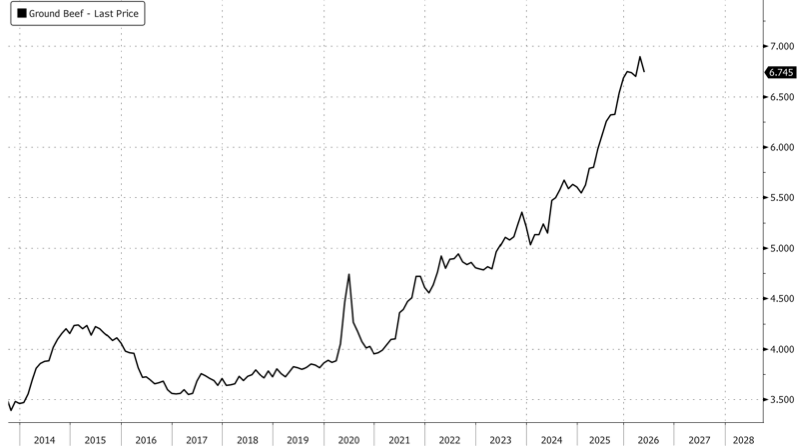
Bank of America analysts spoke with Oklahoma State University agricultural economist Derrell Peel, who offered new insight into the US cattle cycle. His key takeaway: the herd-rebuilding phase may not meaningfully begin to turn until near the end of the decade, suggesting elevated beef prices at the supermarket are here to stay.
The most important issue in the beef industry is when the cattle cycle will turn. The US beef cow herd is the smallest since 1961, while the 2025 calf crop is the smallest since 1941. Beef production is expected to decline by 4.5% to 5% in 2026 and continue falling through at least 2027, despite heavier carcass weights partially offsetting lower slaughter volumes.
Peel explained to Sara Senatore, a BofA Securities research analyst covering restaurants, protein processors, and food and beverage, that the beef industry has not yet seen the tightest supplies because meaningful heifer retention has only just begun.
He added that if ranchers begin saving heifer calves in 2026, those animals would be bred in 2027, calve in 2028, and only begin adding to supply in 2029 or 2030.
Peel explained more about when the cattle rebuilding cycle could turn:
The bottom line is, I don't think we're saving very many heifers yet. I don't think we're doing more than perhaps slowing the liquidation down, or stabilizing the herd. We're certainly not going to expand any in 2026. I think the prospects for expansion in 2027 are very limited at this point, because again we know that the supply of heifers that's already on the ground, that we would need to be breeding this year to enter the herd next year, just isn't there.
And so if we start saving