Authored by David DeMay via AmericanThinker.com,
Ask most Silicon Valley billionaires what they think about death, and you’ll get some version of a declaration of war. Peter Thiel has funded life-extension research for years and has spoken openly about wanting to “fight death.” Jeff Bezos, Sam Altman, and a growing circle of biotech-backed investors have likewise poured billions into companies pursuing not merely longer life, but the possibility of radically slowing or even ending human aging.
Elon Musk - the wealthiest of them all and arguably the most publicly concerned with humanity’s long-term survival - has consistently argued almost the opposite.
Speaking at the World Economic Forum Annual Meeting in conversation with Larry Fink, Musk remarked, “There is some benefit to death.”
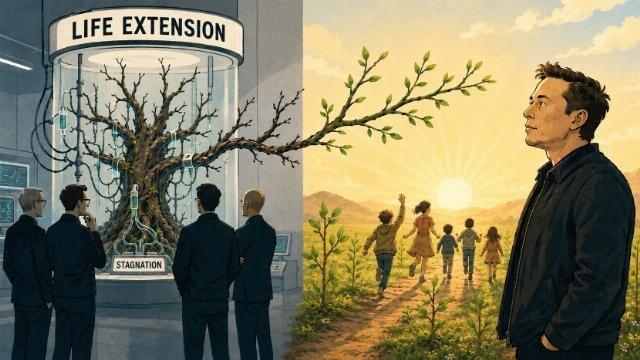
He warned that dramatically extending human lifespans could lead to “an ossification of society,” leaving institutions increasingly rigid and ideas “stultifying” as the same generation remained in power indefinitely.
His reasoning is straightforward. Most people form their core worldview relatively early in adulthood and rarely change it fundamentally. If those individuals never leave positions of influence, society risks locking one generation’s assumptions permanently into its political, economic, and cultural institutions. In Musk’s view, mortality is not merely a biological limitation; it is one of the mechanisms by which civilizations renew themselves.
What makes his position especially interesting is that it is n