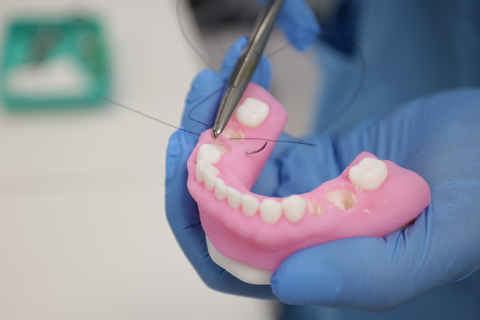
3D printer OEMStratasyshas introduced a dental anatomical model preset designed for simulation-based education and clinical training. The multi-material 3D printed solution offers a synthetic alternative to cadavers, animal specimens, and stone models, addressing cost, variability, and ethical concerns that continue to affect traditional training environments.
As dental education increasingly incorporates digital workflows, institutions are seeking standardized models that provide realistic anatomy without the storage, biohazard, and approval requirements associated with biological materials. The new preset is positioned to support consistent, scalable hands-on learning across classrooms, clinics, and product demonstrations.
Multi-Material Technology for Anatomical Accuracy
The preset uses predefined material parameters to control how multiple polymers are blended and distributed within a single print. This approach enables the production of dental and musculoskeletal structures that replicate the biomechanical response of bone, teeth, nerves, and soft tissue while maintaining repeatability across batches.
Unlike conventional plastic models, which often lack detailed anatomical behavior, or biological specimens that vary from case to case, the fully synthetic models provide predictable performance and can be manufactured at scale. Built using Stratasys’ multi-material additive manufacturing systems, they allow realistic drilling, cutting, suturing, implant placement, and other procedural simulations.
The models can be generated from Cone-Beam Computed Tomography (CBCT) scan data to replicate patient-specific conditions and complex cases, including atrophic jaws, sinus elevation procedures, and bone grafting scenarios. They are suitable for a broad range of interventions such as extractions, implant placement, periodontal and endodontic surgery, and sinus augmentation.
Applications Across the Dental Ecosystem
The solution is intended for dental schools, training centers, and medical device manufacturers. OEMs can use anatomically accurate replicas to support product validation and clinician demonstrations, potentially shortening development timelines. Training facilities can replace specimen-based labs with on-demand scenarios that simplify operations. Academic institutions can provide students with repeated exposure to realistic cases before transitioning to live patient care.
“With this preset for dental anatomical models, we are entering a new segment of digital dental education and clinical simulation, helping customers move beyond traditional training methods toward more standardized, technology-driven learning environments,” said Erez Ben Zvi, VP Medical at Stratasys. “By combining anatomical realism with repeatability and customization, we’re enabling educators, clinicians, and device manufacturers to prepare for real-world procedures with greater confidence and consistency.”
The dental preset adds to a broader library of anatomical configurations developed to simulate various tissue types, supporting expanded use of additive manufacturing in medical research and professional education.
Source: 3D Printing Industry
