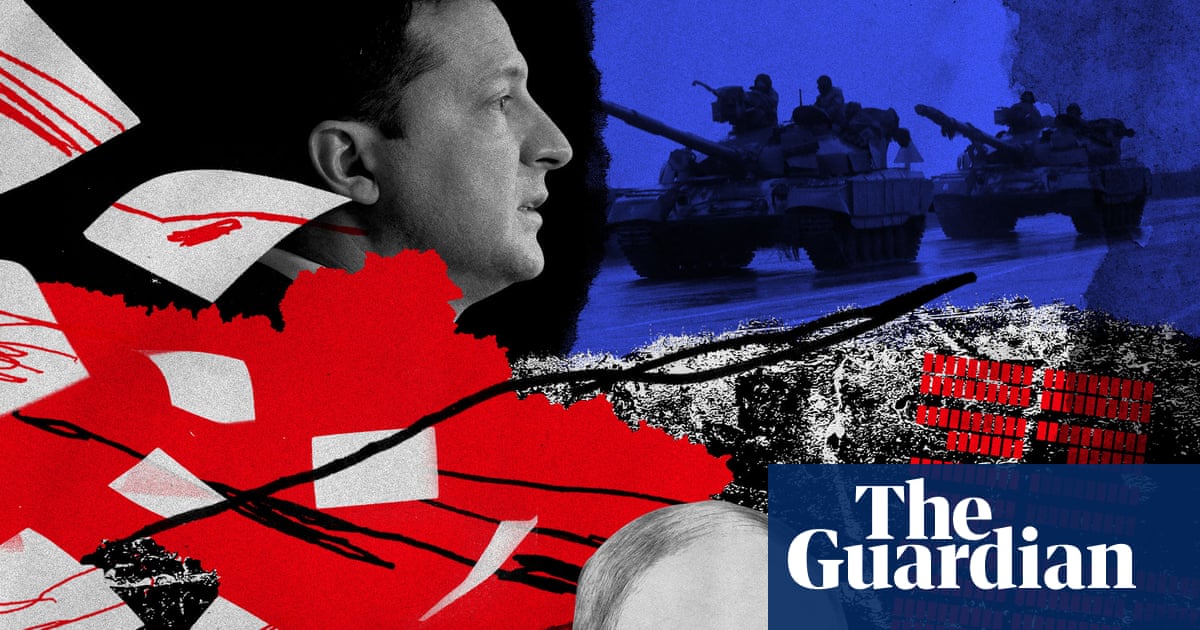
Drawing on more than 100 interviews with senior intelligence officials and other insiders in multiple countries, this exclusive account details how the US and Britain uncovered Vladimir Putin’s plans to invade, and why most of Europe – including the Ukrainian president, Volodymyr Zelenskyy – dismissed them. As the fourth anniversary of the invasion approaches and the world enters a new period of geopolitical uncertainty, Europe’s politicians and spy services continue to draw lessons from the failures of 2022
William Burns had travelled halfway around the world to speak withVladimir Putin, but in the end he had to make do with a phone call. It was November 2021, and US intelligence agencies had been picking up signals in the preceding weeks that Putin could be planning to invade Ukraine. President Joe Biden dispatched Burns, his CIA director, to warn Putin that the economic and political consequences if he did so would be disastrous.
Fifteen years earlier, when Burns was US ambassador in Moscow, Putin had been relatively accessible. The intervening years had concentrated the Russian leader’s power and deepened his paranoia. Since Covid had emerged, few had been granted face time. Putin was squirrelled away at his lavish residence on the Black Sea coast, Burns and his delegation learned, and only phone contact would be possible.
A secure line was ready in an office at the presidential administration building on Moscow’s Old Square, and Putin’s familiar voice came through the receiver. Burns laid out the US belief that Russia was readying an invasion ofUkraine, but Putin ignored him and ploughed on with his own talking points. His intelligence agencies had informed him, he said, that there was an American warship lurking over the Black Sea horizon, equipped with missiles that could reach his location in just a few minutes. It was evidence, he suggested, of Russia’s strategic vulnerability in a unipolar world dominated by the US.
The conversation, as well as three combative face-to-face discussions with Putin’s top security officials, seemed extremely ominous to Burns. He left Moscow far more concerned about the prospect of war than he had been before the trip, and he relayed his gut feeling to the president.
“Biden often asked yes/no questions, and when I got back, he asked if I thought Putin was going to do it,” Burns recalled. “I said: ‘Yes’.”
Three and a half months later, Putin ordered his army into Ukraine, in the most dramatic breach of the European security order since the second world war. The story of the intelligence backdrop to those months – how Washington and London garnered such detailed and accurate insight into the Kremlin’s war plans, and why the intelligence services of other countries did not believe them – has never before been told in full.
This account is based on interviews conducted over the past year with more than 100 intelligence, military, diplomatic and political insiders in Ukraine, Russia, the US and Europe. Many spoke without attribution to discuss events that are still sensitive or classified; those quoted by name are referred to by their job titles at that time.
It is the story of a spectacular intelligence success, but also one of several intelligence failures. First, for the CIA andMI6, who got the invasion scenario right but failed to accurately predict the outcome, assuming a swift Russian takeover was a foregone conclusion. More profoundly, for European services, who refused to believe a full-scale war in Europe was possible in the 21st century. They remembered the dubious intelligence case presented to justify the invasion of Iraq two decades previously, and were wary of trusting the Americans on what seemed like a fantastical prediction.
Most crucially, the Ukrainian government was thoroughly unprepared for the oncoming assault, with PresidentVolodymyr Zelenskyyspending months dismissing increasingly urgent American warnings as scaremongering, and quashing last-minute concerns among his own military and intelligence elite, who eventually made limited attempts to prepare behind his back.
Source: Drudge Report