Freddie Ponton21st Century Wire
Donald Trump hasten daysto decide whether to bomb Iran. That was the message from the White House on February 19 as the USS Abraham Lincoln and the Gerald R. Ford steamed toward the Persian Gulf with F-35s and F-22s marshalling on flight decks for potential strikes. The ultimatum was meant to force capitulation and coerce Iran to negotiate or face the consequences. Instead, it produced something Washington never anticipated. A Russian frigatedocked in Bandar Abbas. Joint naval drills began in the Gulf of Oman, while Iranian Revolutionary Guardsclosed the Strait of Hormuzfor military exercises that looked remarkably like rehearsals for war.
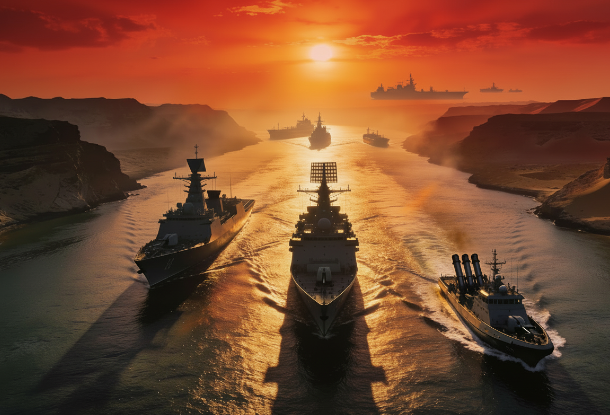
The Russian helicopter carrierCruiserslipped into Bandar Abbas on the same morning Trump’s deadline made headlines—its sailorsminglingwith Iranian counterparts on a pier that had never before hosted a NATO adversary. Three hundred miles away, theChinese destroyers loitered in the Arabian Sea, whilst in the Strait of Hormuz, Iranian speedboats buzzed past American warships in coordinated defiance. For the first time since 1945, the United States did not control the terms of engagement in the world’s most vital waterway.
What appeared to Western observers as a regional crisis was, in retrospect, the opening phase of a fundamental restructuring, led by the operationalisation of a “multipolar world order in the ocean.” This phrase, until recently confined to the theoretical pronouncements of Russian strategists and Belt and Road planning documents, was being forged in the waters of the Indian Ocean, the Arctic, and the South China Sea through a convergence of interests that united three powers separated by geography but united by a common adversary.
To understand what happened in the Gulf in 2026, one must abandon the comfortable fiction that this was simply about Iranian nuclear ambitions or Houthi piracy. It was about the fundamental restructuring of how security is produced, who provides it, and who gets to write the rules of the world’s most important trade routes. And most critically, it was about how Washington, through seven decades of policy miscalculation, built the verycoalition of the sanctionedthat now challenges its supremacy.
The Underestimation: How Washington Built Its Own Replacement
The February 2026 convergence was not an accident. It was the predictable culmination of American strategic myopia.
For two decades, Washington operated on a set of assumptions that proved catastrophically wrong. The sanctions regime, imposed with escalating severity from 2010 to 2025, was designed to fracture the Russia-Iran relationship to make Tehran so economically desperate that it would abandon its regional ambitions and its partnerships with Moscow. Instead, sanctions created the opposite—the pressure forging solidarity rather than submission.
The real moment of convergence arrived not in a war room, but in the middle of a banking crisis. In 2024, when Washington imposedmaximum sanctions, freezing the assets of selected individuals and entities, Moscow and Beijing had already built the escape infrastructure. Barter arrangements, yuan-denominated energy contracts, and SWIFT workarounds that Russia had stress-tested for years were already in place.
The coalition wasn’t born through diplomatic cables. It was forged in the shared experience of watching the same weapon—financial exclusion—deployed against all three.
Source: 21st Century Wire
