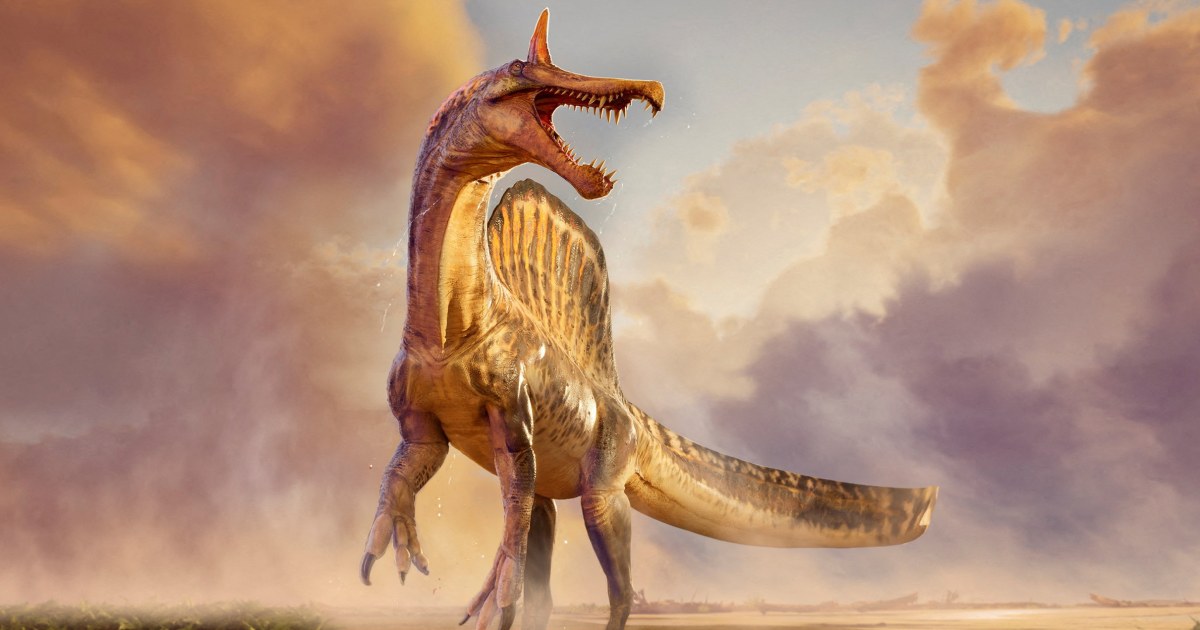
At a remote and barren Sahara desert site in Niger, scientists have unearthed fossils of a new species of Spinosaurus, among the biggest of the meat-eating dinosaurs, notable for its large blade-shaped head crest and jaws bearing interlocking teeth for snaring slippery fish.
It prowled a forested inland environment and strode into rivers to catch sizable fish like a modern-day wading bird — a “hell heron,” as one of the researchers put it, considering it was about 40 feet long and weighed 5-7 tons.
The dinosaur presented a striking profile on the Cretaceous Period landscape of Africa some 95 million years ago as it hunted large fish like coelacanths in the region’s waterways. Its bony cranial crest, about 20 inches tall, resembled a curved sword called a scimitar, and it had a large sail-like structure on its back and an elongated crocodile-like snout.
Along with the existing genus name Spinosaurus, meaning “spine lizard,” the researchers gave it the species name mirabilis, meaning “astonishing,” referring to its crest. A genus is a group of closely related species bearing similar traits. For example, lions and tigers are the same genus but different species.
It is only the second known species of Spinosaurus, a dinosaur that has gained fame in popular culture for its depiction in the “Jurassic Park” movies. The other one, Spinosaurus aegyptiacus, was named in 1915 based on fossils from Egypt.
Spinosaurus, the only known semiaquatic dinosaur predator, joins Tyrannosaurus, Giganotosaurus and Carcharodontosaurus among the largest meat-eating dinosaurs.
The two Spinosaurus species, which were contemporaneous, shared the same general body plan including long dorsal spines forming the sail-like structure and a skull adapted for hunting fish. The crest of Spinosaurus mirabilis is much larger compared to Spinosaurus aegyptiacus, and it has a more elongated snout, teeth more spread out from each other and longer hind limbs.
The researchers said its crest likely was for display, since it appears too fragile to have been used as a weapon, even though it was solid bone without the air sacs present in some other dinosaur crests. The crest, probably sheathed in keratin like a bull’s horns, may have been vividly colored and instrumental in sexual or territorial competition or recognition between individuals.
“It’s about love and life — attracting a mate, defending your hot feeding shallows,” said University of Chicago paleontologist Paul Sereno, lead author of the research published on Thursday in the journal Science. “What else could be more important?”
The retracted location of its nostrils, farther back than usual, let it submerge most of its snout under water to stalk swimming prey for as long as necessary while breathing normally. In addition, its upper and lower rows of teeth fit neatly together during a bite, called interdigitation.
Source: Drudge Report