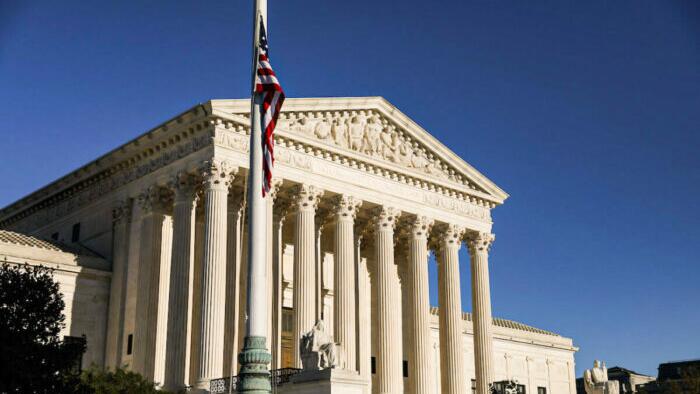
The Supreme Court on Tuesdaystruck downTrump's tariffs.In a 170-page decision and a 6-3 vote, the court ruled thatTrump's use of the 1977 International Emergency Economic Powers Act (IEEPA)- which constitute about half of the tariffs we've seen under Trump - was not lawful.
"IEEPA does not authorize the President to impose tariffs," wrote the court.
The ruling stems from a consolidated challenge brought by small businesses and multiple states,who argued that the statute - originally intended to authorize sanctions and asset freezes during national emergencies - does not grant the executive branch the power to levy taxes on imports.Writing for the majority,the Court emphasized that the Constitution vests Congress alone with the authority to impose duties and tariffs, and found that IEEPA’s authorization to “regulate … importation” cannot be interpreted to include the distinct taxing power required to enact broad-based tariffs. As a result, the Court affirmed lower-court rulings blocking the challenged measures, concluding that the administration’s emergency-based tariff framework exceeded the limits of the statute.
Trump invoked IEEPA to impose his 'reciprocal' tariffs on nearly every foreign trade partner to address what he called a national emergency over US trade deficits. He invoked it again to impose tariffs onChina, Canada and Mexicoover fentanyl trafficking into the United States.
The decision turns on the Court’s conclusion that tariffs are not merely a tool for regulating trade, but a form of taxation that the Constitution reserves to Congress. Citing Article I, Section 8, the majority stressed that the power to impose tariffs is “very clear[ly] … a branch of the taxing power,” and that the Framers gave Congress “alone … access to the pockets of the people.”The administration had argued that IEEPA’s grant of authority to “regulate … importation” permitted the President to impose tariffs in response to declared national emergencies. But the Court rejected that interpretation, noting that while “taxes may accomplish regulatory ends, it does not follow that the power to regulate includes the power to tax as a means of regulation.”
The majority also pointed to the statute’s text, emphasizing that IEEPA authorizes the President to “investigate, block … regulate, direct and compel, nullify, void, prevent or prohibit” certain transactions - yet makes no mention of tariffs or duties.
“Had Congress intended to convey the distinct and extraordinary power to impose tariffs,” the opinion states, “it would have done so expressly, as it consistently has in other tariff statutes.”
The Court further highlighted that in the nearly 50 years since IEEPA’s enactment, “no President has invoked the statute to impose any tariffs,” describing that lack of historical precedent — combined with the sweeping economic impact of the measures at issue - as a “telling indication” that the asserted authority falls outside the President’s legitimate reach.
Applying what it characterized as the “major questions” framework, the Court reasoned thatCongress would not delegate such sweeping control over trade policy through vague language.The President’s claim that two words -“regulate” and “importation”- authorize tariffs “of unlimited amount and duration, on any product from any country,” the majority wrote, would represent a “transformative expansion” of executive authority over tariff policy and the broader economy.
During arguments on Nov. 5,the court seemed skeptical over Trump's authority to use IEEPA, leading most observers observers, including betting markets, to conclude a high probability they're struck down at least in part. The Trump administration is appealing lower court rulings that he overstepped his authority, while Trump himself said a Supreme Court ruling against the tariffs would be a "terrible blow" to the United States.
Source: ZeroHedge News