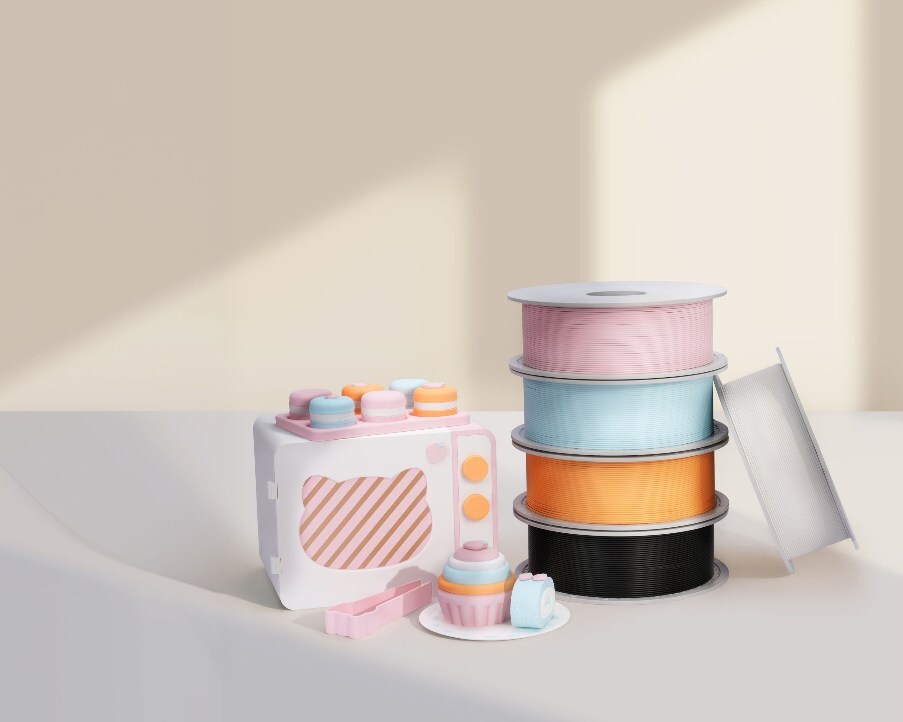
Home-Bambu Lab Launches PLA Pure, a New Filament Engineered for Safer Home Printing
Shenzhen-based desktop 3D printer manufacturerBambu Labhas introduced PLA Pure, a new filament developed for consumer 3D printing environments where safety, air quality and material traceability are priorities. The launch is positioned as a response to growing demand for cleaner, more transparent materials as desktop printers become increasingly common in homes, shared spaces and households with children.
A Formula Built From the Ground Up
PLA Pure is composed of five ingredients, polylactic acid derived from corn and sugarcane, an acrylic copolymer, colour pigments, ethylene bis-stearamide and talc, each verified for compliance with EU 10/2011, the European regulation governing plastics intended for food contact. Every ingredient carries a traceable Food Contact Material substance number and is sourced from established global manufacturers includingTotalEnergies Corbion,Chemours, Dow, andBASF.
What distinguishes PLA Pure from most filaments marketed as food-contact compliant is the level at which verification takes place. Most products of this type are tested only as finished items. PLA Pure is verified ingredient by ingredient, from the base resin to the pigments.
The formulation also eliminates the impact modifiers and flow agents typically used to achieve consistent print results, requiring Bambu Lab to rebuild the chemistry from scratch to deliver performance without additives. The result is reduced stringing even without prior drying, cleaner surface finishes with less post-processing, and mechanical performance consistent with standard PLA Basic.
Indoor Air Quality and Toy Safety
Since desktop printing typically occurs in living spaces, Bambu Lab has obtained UL 2904 GREENGUARD certification for PLA Pure, the recognised standard for measuring particulate matter and VOC emissions from 3D printers. Testing conducted on Bambu Lab’s A1 and A2L open-deck printers, representing a baseline emissions scenario without enclosure or filtration, found that PM2.5 and PM10 levels during a four-hour continuous print fell below those of a comparable filament under identical conditions and below what is typically present in an average kitchen, living room, or office. Ventilation is still recommended.
The material has also passed EN 71-3 certification, the European standard governing the migration of potentially harmful elements, including lead, cadmium and chromium, from toy materials. This makes PLA Pure suitable for printed objects intended to be handled or played with, from toy kitchen items to small models, though standard precautions around sharp edges, small parts and supervision remain applicable.
All printing parameters are stored in an RFID tag and read automatically by Bambu Lab’s AMS system, removing manual configuration from the process. PLA Pure is available now from the Bambu Lab official store, priced at $24.99 with spool and $21.99 as a refill.
Source: 3D Printing Industry
