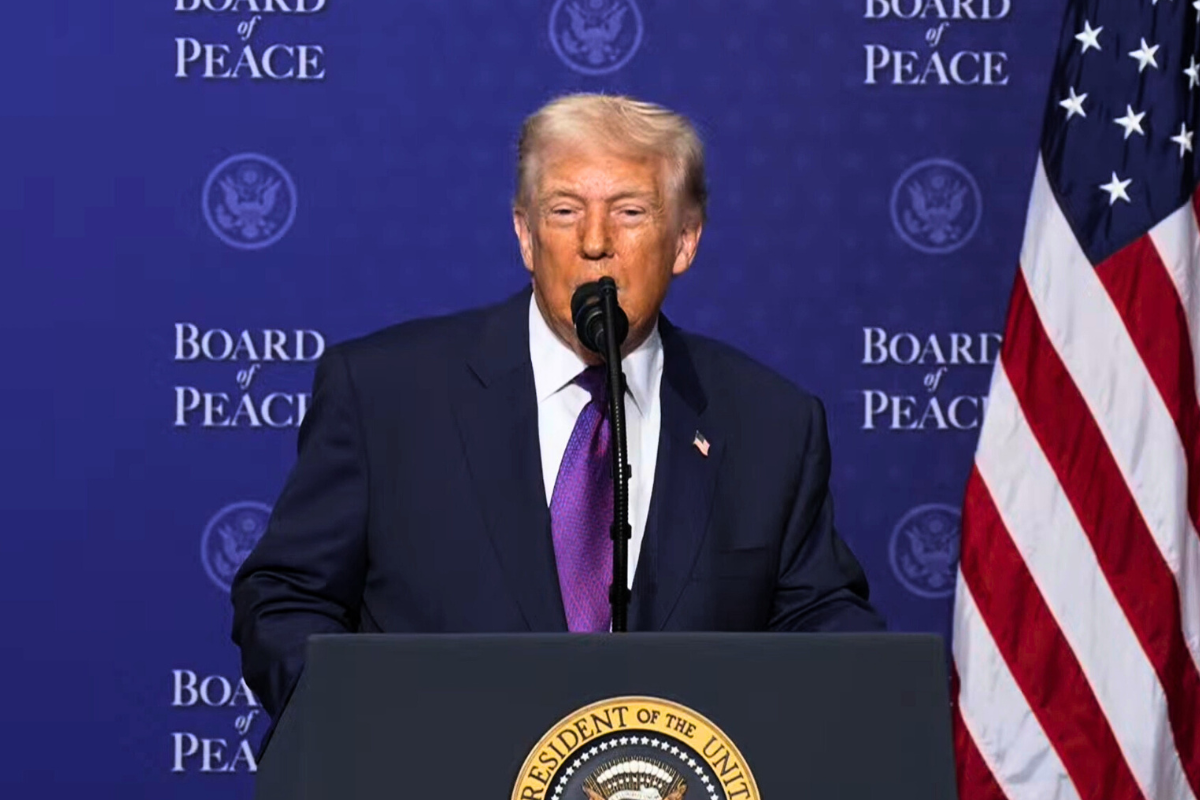
On Thursday,President Donald Trumppromised $10 billion (£7.4 billion) to rebuild Gaza. This same week, his administration quietly authorised the arrest of refugees already living legally in America.
The optics couldn't be starker. Peace abroad. Enforcement at home. And for thousands of refugees in Minnesota and beyond, the contradiction isn't abstract. It's personal.
Trump convened more than 40 nations at the US Institute of Peace, now renamed in his honour, for the inauguralBoard of Peacesummit. According to Axios, member countries pledged an additional $7 billion (£5.2 billion) for Gaza's recovery. Indonesia committed 8,000 troops to a new international stabilisation force. Qatar pledged $1 billion (£744 million). The UAE added $1.2 billion (£892 million).
FIFA President Gianni Infantino, who briefly wore a red MAGA-style hat during the event, announced $75 million (£56 million) for football infrastructure in Gaza. Plans include a 25,000-seat stadium.
'That number is a very small number when you look at that compared to the cost of war,' Trump said. 'That's two weeks of fighting.'
But where's the money coming from? TheWhite Housedidn't say. Senator Chris Murphy, a Democrat from Connecticut,called the pledge 'totally illegal'on social media, questioning whether Congress had authorised such spending.
While cameras focused on Washington, a Department of Homeland Security memo dated 18 February changed the rules for refugees who came to America legally.
The directive, signed by USCIS Director Joseph Edlow and acting ICE Director Todd Lyons, instructs agents to 'arrest and detain' refugees who haven't obtained green cards after one year. Under previous guidance from 2010, this was an administrative matter. Not grounds for arrest.
'This policy is a transparent effort to detain and potentially deport thousands of people who are legally present in this country,' Beth Oppenheim, CEO of refugee agency HIAS, told NPR. 'They were promised safety and the chance to rebuild their lives. Instead, DHS is now threatening them with arrest and indefinite detention.'
Here's the catch: many refugees can't complete their applications. The administration paused processing for nationals from travel-ban countries in December. They're stuck in a bureaucratic bind, unable to comply with a rule the government itself blocked them from meeting.
Source: International Business Times UK
