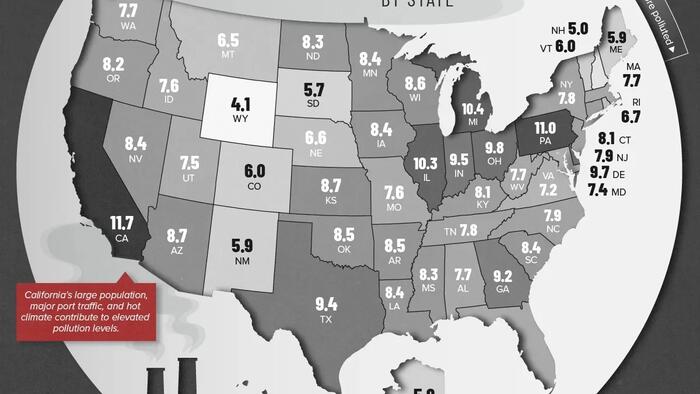
Wyoming’s air contains less than half the particle pollution found in California.
Across the country, fine particle pollution levels range from just over 4 µg/m³ to nearly 12 µg/m³, a gap shaped by wildfire exposure, population density, and industrial activity.
This map,via Visual Capitalist's DorothY Neufeld, ranks all 50 states by average particle pollution, based on EPA data from theAmerica’s Health Rankings 2025report.
For the analysis, states were analyzed using 2022 to 2024 average fine particle pollution (µg/m³).
The U.S. average stood at 8.8 µg/m³, exceeding the World Health Organization’s (WHO) air quality guideline of 5 µg/m³. That means the average American is breathing air that falls short of global health standards.
Below, we rank states from best to worst by air pollution levels. Where does your state rank?
Wyoming has the best air quality in the U.S., known for its vast stretches of land and the nation’s smallest population.
Adding to this, Wyoming’s city of Casper has thelowest year-round particle pollutionacross U.S. metros. Cheyenne, meanwhile, ranked eighth overall.
Hawaii ranks second by particle pollution, at 4.7 µg/m³. The state’s low population density, along with strong winds and rainfall, plays a key role in its air quality. While rain helps to clear away pollutants, trade winds bring in fresh air and mitigate the accumulation of air pollutants.
Overall, just three states—Wyoming, Hawaii, and New Hampshire—have air quality that falls within WHO’s guidelines.
Source: ZeroHedge News
