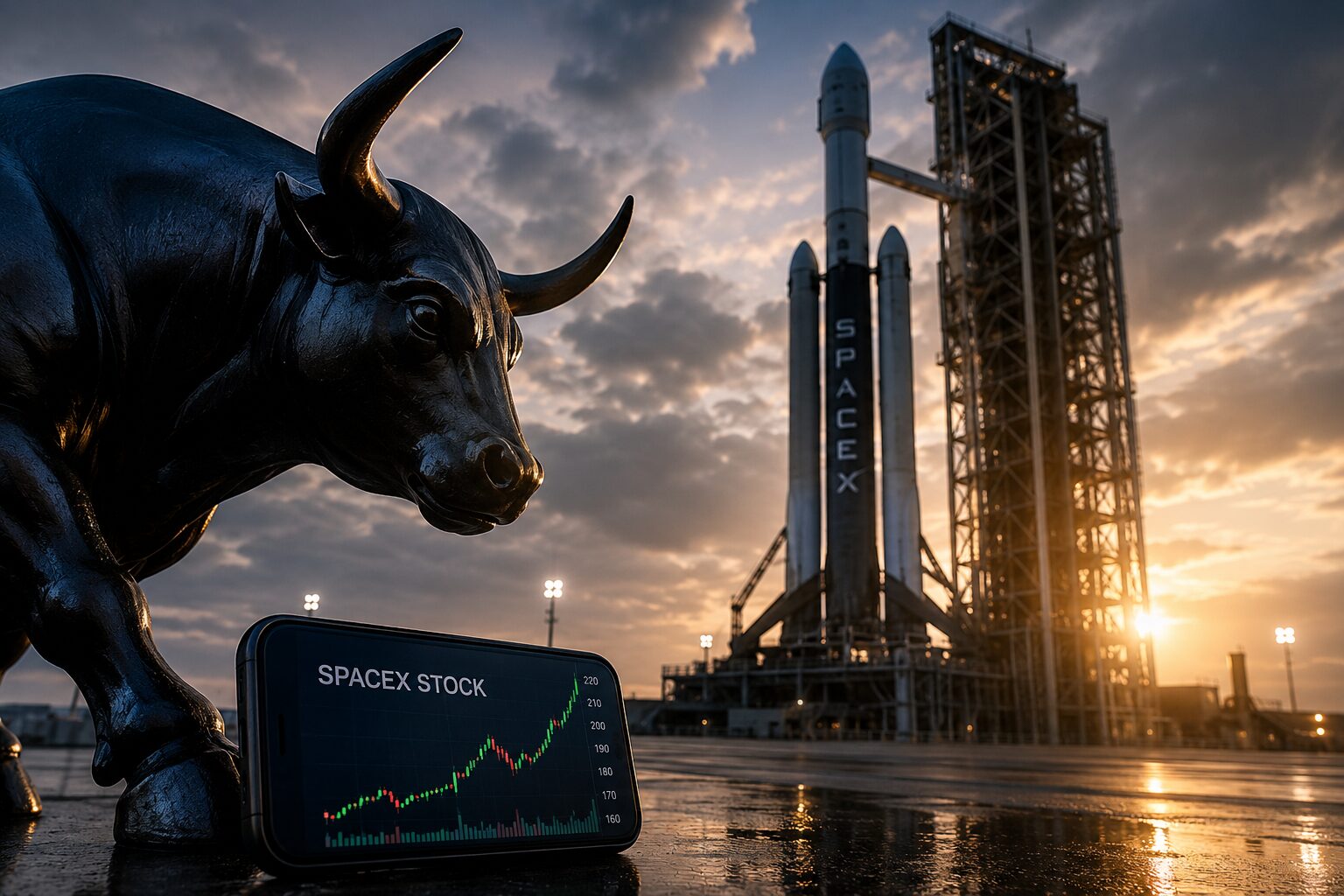
SpaceX stock price prediction has become one of the sharpest debates on Wall Street since Space Exploration Technologies (NASDAQ: SPCX) went public on June 12, 2026, at $135 per share, the largest IPO in history. Shares climbed past $200 within just a few days, pushing the company’s market cap above $2.5 trillion. At roughly 115 times trailing sales right now, the stock trades 95% richer than Palantir, currently the priciest name in the S&P 500.
Whether $1,000 invested today grows or shrinks by 2027 is the central question for anyone considering SPCX, and the SpaceX stock price prediction after IPO varies so wildly that the answer depends almost entirely on which analysts you believe. The SpaceX stock valuation debate is also running up against a historical pattern that tends to go poorly for investors who buy large IPOs in their first year.
Also Read:Micron Stock Bullish Momentum: Should You Buy MU Ahead of Earnings?
Five analysts have so far published 12-month price targets since the IPO, with an average of $164, a high of $227, and a low of $63, according to S&P Global data. That spread also reflects just how speculative the SpaceX story is at this valuation.
Morningstar analystNicolas Owensput fair value at $63 per share, 65% below where shares traded as of June 16. His probability-weighted discounted cash flow model concludes the stock is significantly overvalued in all but the most optimistic scenario. After the first trading day, he wrote:
“With a small initial float boosted by almost every investment bank on the planet, buoyant investor appetite for AI infrastructure bids, and an unprecedented path to inclusion in the Nasdaq 100 Index just 15 trading days after the IPO, we expect SpaceX’s share price will likely survive separation and even ascend toward orbit, at least for a time.”
Owens assigned just a 7% probability to the “Moonshot” scenario, the only case where the SpaceX stock price prediction comes close to matching current prices. That scenario requires both Starship achieving full rapid reusability and orbital AI data centers scaling commercially before 2028. Neither engineering problem has been solved yet. CFRA also initiated coverage on the first trading day with a sell rating and a 12-month target of $115. NewStreet Research started at buy with a $165 target, though their analyst acknowledged the valuation only works “over a kind of 20 to 25-year time frame.” The consensus average of $164 sits below where shares traded at the time of writing.
The SpaceX stock price prediction for 2027 spans a gap wide enough to turn $1,000 into either $310 or $1,120, depending on how things play out. History offers one useful reference point. Among the 15 largest U.S. IPOs since 2006, the average stock dropped 33% during the first year and fell as much as 50% at some point in that window. Meta, Uber, Rivian, Coinbase, and Robinhood all appear on that list.
On the near-term technical side, TD Securities head of index and market structure Peter Haynes told CNBC that “the most important dates for SpaceX haven’t happened yet,” pointing to July 6, when the Nasdaq-100 rebalances to include SPCX. That event alone could force an estimated $22 to $27 billion in passive ETF buying, also a reason some investors watch the next few weeks closely regardless of the valuation debate.
Investors considering whether to buy SpaceX stock also face a governance question that does not show up in any price target. Elon Musk retains roughly 82.4% of SpaceX’s voting power, so public shareholders carry full economic risk with virtually no say in how the company operates. SpaceX’s revised S-1 also warns the company may issue significant equity in future transactions, adding further uncertainty to an already hard-to-model investment. The SpaceX stock valuation is, right now, priced for outcomes that most analysts say remain far from certain, and the SpaceX stock price prediction range of $63 to $227 captures just how wide that uncertainty runs.
Source: Watcher Guru
