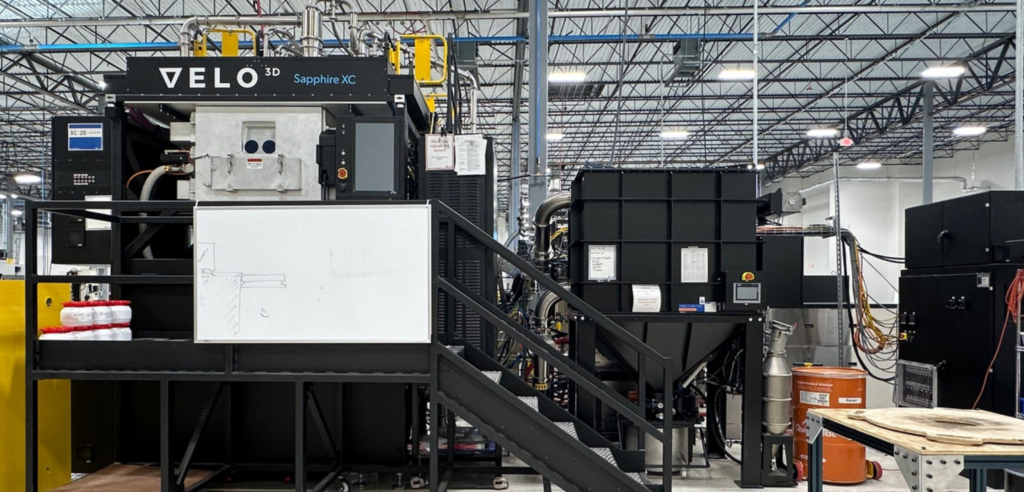
US-based metal 3D printer manufacturerVelo3Dhas secured an $11.5 million, multi-year full-rate production agreement with an undisclosed U.S. defense contractor. The contract supports a “sensitive” nationally security program.
According to the company, the agreement will use Velo3D’s Rapid Production Solution (RPS) which combines industrial-scale Laser Powder Bed Fusion (LPBF) technology with its manufacturing software and workflows. The system is intended to produce mission-critical metal components with faster delivery times and lower costs compared to traditional subtractive methods.
Large-Format, High-Precision Metal 3D Printing
Velo3D states that its Sapphire systems, which are manufactured and assembled in the United States, can repeatedly produce parts up to 600 mm in diameter and one meter in height across its installed fleet. The company also highlights in-situ, layer-by-layer process monitoring as part of its quality assurance approach.
“This multi-year full rate production contract signals the trust and confidence our customers have in Velo3D to scale programs rapidly through faster part delivery, enhanced reliability and the surge capacity needed to meet evolving demands of their customers,” said Dr. Arun Jeldi, CEO of Velo3D.
In defense environments, thelimiting factor for additive manufacturingis no longer machine capability, but whether systems are mature enough to meet qualification, procurement, and deployment requirements. Technologies must pass Technology Readiness Level (TRL) and Manufacturing Readiness Level (MRL) thresholds before integration into operational programs, yet certification pathways and digital thread infrastructure remain inconsistent across programs.
Procurement adds further friction, with acquisition cycles often lagging behind the technologies they are meant to evaluate. Questions around intellectual property, licensing, and liability, particularly when adapting legacy components for additive production, continue to complicate deployment. These constraints collectively narrow the field: systems that can demonstrate repeatable, fleet-wide output at production scale with validated processes are the ones positioned to clear full-rate production thresholds.
The bar for reaching full-rate production is demonstrably high. Recently, Velo3D was designated the first approved additive manufacturing provider under theU.S. Army Ground Vehicle Systems Center’s (GVSC) CRADA framework after completing qualification steps in less than two weeks.
The program includes validation of components produced in Aluminum CP1 and Inconel 718 using both standard and large-format systems, with resulting parts evaluated for integration intoTACOM’s sustainment supply structure, which carries its own traceability and documentation requirements.
On the certification side, thePerformance Review Institute(PRI), which administers the Nadcap accreditation program, requires powder bed fusion (PBF) suppliers to demonstrate traceability of build parameters, documented process control, andrepeatable output across production runs, not just isolated build success. Systems that cannot prove consistency across a fleet do not clear this threshold.
Source: 3D Printing Industry
