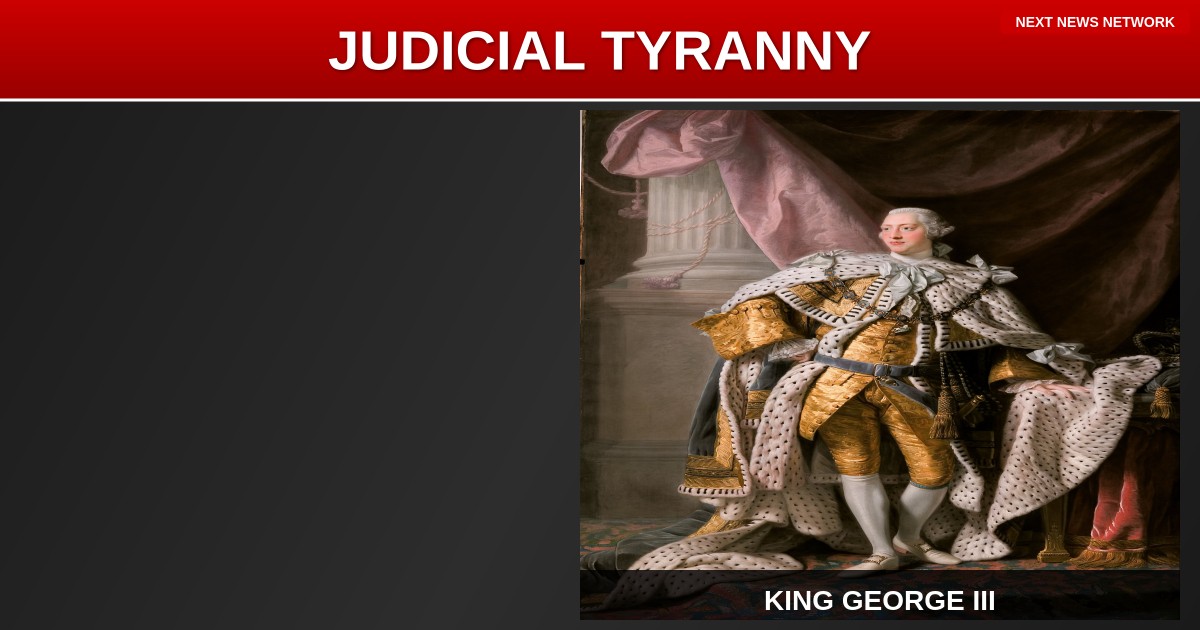
In a stunning rebuke to the foundations of American democracy, federal judges are wielding unprecedented power, surpassing even the tyrannical reach of King George III that sparked the Revolutionary War. Critics, including prominent conservative voices, argue that unelected lifetime appointees are now dictating national policy through nationwide injunctions, effectively nullifying the will of voters and the executive branch. This judicial overreach has escalated in recent years, transforming courtrooms into de facto legislatures where a single judge in Hawaii or Texas can halt policies affecting 330 million Americans.
The phenomenon traces back to high-profile cases during the Trump administration, where district judges routinely blocked executive orders on immigration and border security. A federal judge in California, for instance, issued a sweeping injunction against the "Remain in Mexico" policy, forcing the reversal of measures aimed at curbing illegal crossings. More recently, under the Biden era, similar tactics have targeted vaccine mandates and environmental regulations, with judges in liberal strongholds overriding agency decisions. These rulings, often based on novel interpretations of the Administrative Procedure Act, allow individual jurists to impose their policy preferences nationwide, a tool rarely used before the 1960s.
Historical context underscores the gravity of this shift. The Declaration of Independence railed against King George's suspension of colonial legislatures and imposition of judges dependent on his will. Yet today's federal judiciary, insulated by life tenure and unchecked by popular election, exercises far broader authority—striking down laws passed by Congress, rewriting statutes through injunctions, and even micromanaging foreign policy. Legal scholars like Josh Blackman of the South Texas College of Law have documented over 60 nationwide injunctions during Trump's term alone, compared to just one under Obama, highlighting a partisan weaponization of the bench.
Proponents of reform decry this as "judge shopping," where litigants forum-shop for sympathetic districts to secure blockbuster stays. The Supreme Court has occasionally rebuked such practices, vacating injunctions in cases like Department of Homeland Security v. New York, but lower courts persist. This dynamic undermines the separation of powers enshrined in the Constitution, rendering elections meaningless when a lone Article III judge can veto the people's mandate. As one analyst noted, "If judges can rule the country from the bench, why bother with ballots?"
The implications for the republic are profound. With upcoming battles over election integrity, gun rights, and Second Amendment challenges, judicial tyranny threatens to entrench elite rule over democratic governance. Calls for legislative fixes, such as limiting injunction scope or imposing circuit-riding requirements, gain traction among conservatives. Until Congress acts or the judiciary self-restrains, the specter of robed monarchs looms larger than any red-coated king ever did, challenging the very sovereignty of the American experiment.
