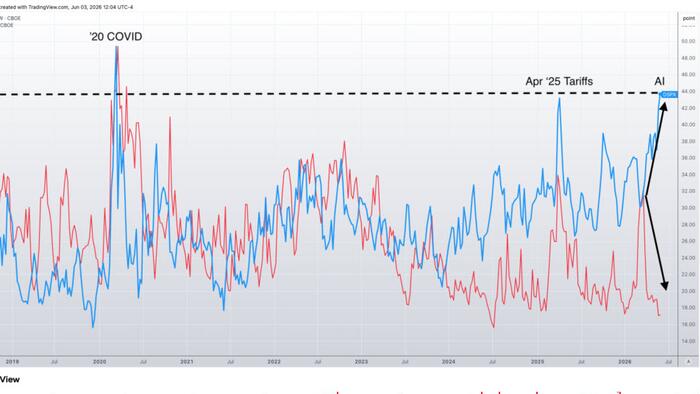
CBOE’s Dispersion Index (DSPX) is at levels only seen during Covid and the April ’25 tariff crash, while Correlation (COR1M) is near all-time lows. This divergence signals extreme positioning risk driven by the AI stock chase, and makes SPY downside hedges historically cheap.
Traders have been chasing AI related names in such heavy-handed fashion that it has now created positioning risk for the stock market.
Encapsulating this view are two popular CBOE options indexes: Dispersion (DSPX) and Correlation (COR1M).
DSPX compares the options prices (IV) of the top US stocks vs SPX IV, and measures how different they are from each other. High dispersion means traders are assigning vastly different options prices to individual names.Today, we have traders frothing to chase upside in MU, SNDK, and the like, while scorning other sectors.
COR1M measures the direction of options prices for top US stocks vs the SPX. During periods of calm we generally see traders bit up call options, and sell SPX options, which creates low correlation. Conversely, when there is a lot of fear in the stock market, correlation spikes as traders sell all stocks and buy SPX options – typically puts.
Currently DSPX (blue) is athighsonly seen since the Covid crash after just passing highs from the April 2025 Tariff drama. Meanwhile, COR1M (red), is nearing it’slowestreading ever.
This gives us a massive never-before-seen divergence (black arrows) between spiking options prices (high dispersion) and only certain stocks surging higher (low correlation).
The previous highs in DSPX came during massive risk-off periods! Why? Because in both 2020 and in 2025 traders were pricing in vastly different risk due to traumatic events:in Covid cruise lines were crashing massively, whereas healthcare stocks were bid.During April ’25 it was aboutparsing tariff winners and losers. These heavy “winners and losers” environment created a lot of dispersion in options prices.
Today the massive dispersion is driven by the chase in AI stocks, which is now at extremes.
Notice, too, how correlation (red)spikedduring those previous events as traders sold stocks sharply lower. In other words: all stocks crashed in Covid/Tariffs (i.e. high correlation), just some stocks crashed harder (high dispersion).
Source: ZeroHedge News
