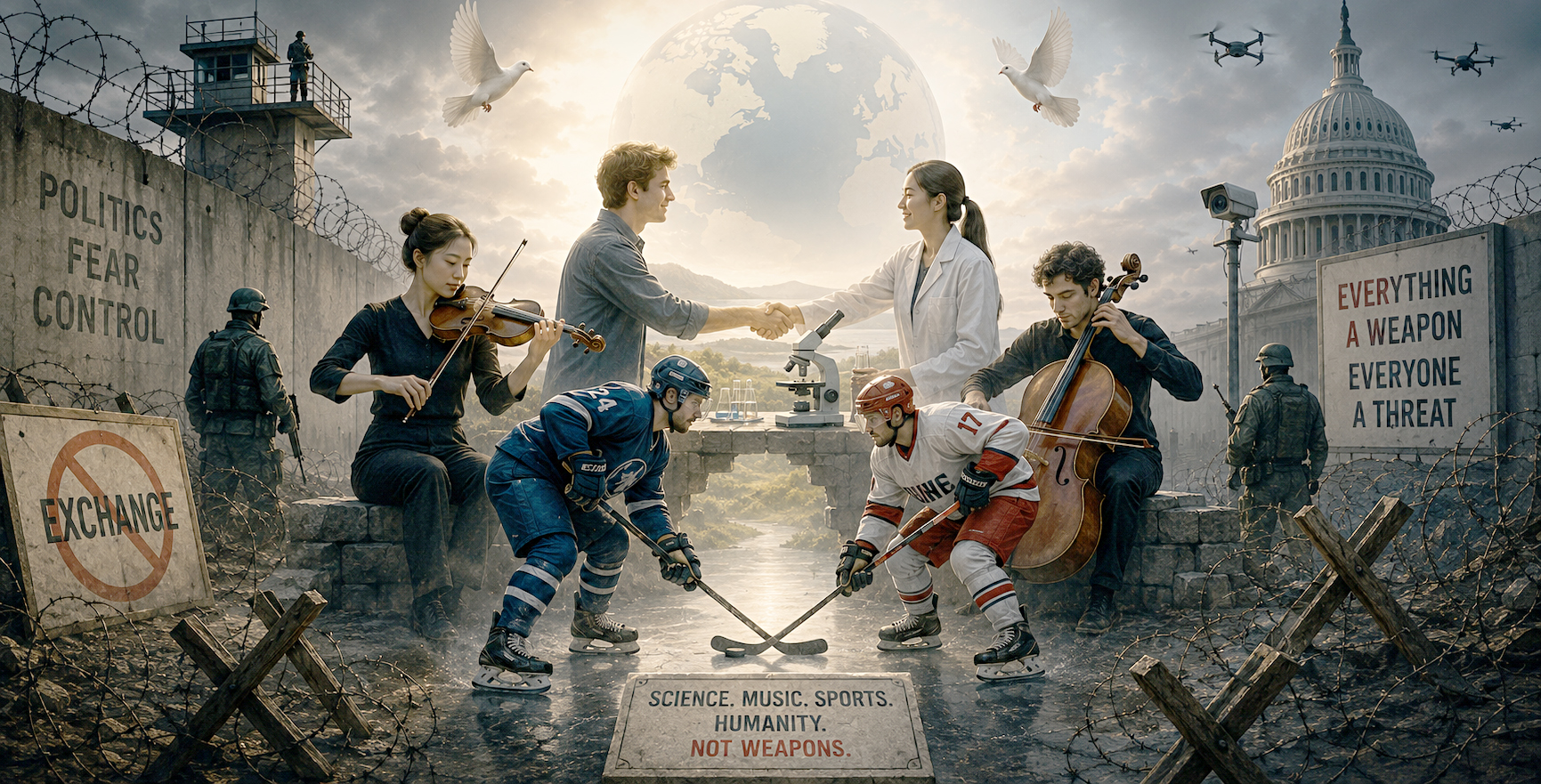
Jan Marco Müller, the European Commission official who drafted the EU’s new science diplomacy framework, just said the quiet part out loud: “Science diplomacy is not about being nice to each other.”
Yes, itis, dumbass. That was the whole point.
For centuries, science diplomacy worked precisely because it allowed ordinary human beings to humanize one another on neutral ground while governments were busy failing.
My good friend,Norman Neureiter, former science advisor to the Secretary of State, defined science diplomacy as “an intentional effort to engage with other countries where the relationship is not good otherwise. The science allows you to deal with non-sensitive issues that both sides can work on together for the good of all.”
That was true for science. It was true for sports. It was true for music, academia, medicine, and cultural exchange more broadly. These were spaces where ordinary people from hostile societies could interact as human beings rather than abstractions, propaganda categories, or geopolitical chess pieces.
During the Peloponnesian War, Greek city-states suspended hostilities during the Olympic truce(ἐκεχειρία)so athletes could compete together despite ongoing conflict. During the Cold War, Soviet and American scientists collaborated through the WHO toeradicate smallpoxbecause viruses, unlike diplomats, do not care about ideology.Apollo-Soyuzdemonstrated that rival superpowers could cooperate in space even while pointing nuclear weapons at each other on Earth. The1972 Summit Seriesbetween Canada and the Soviet Union became more than hockey. Millions of ordinary people on both sides suddenly saw the “enemy” as talented, emotional, funny, proud, exhausted, flawed, and recognizably human.
Even music mattered. In 1987, while the Cold War was still very real, my undergrad’sPeabody Conservatory Symphony Orchestrawent to Moscow and Leningrad. The orchestra did not solve geopolitics, but simply engaged with Soviet music students, argued about phrasing, drank together, traded jokes, and discovered that the terrifying enemy looked remarkably like us.
In the 1950s, at the height of McCarthyism and Stalinism,Soviet scholarswere welcomed at Columbia University. One of them was Alexander Yakovlev, who later became one of the principal intellectual architects of glasnost and perestroika under Gorbachev – a transformation I wrote about in my earlier piece,“The Marketplace of Ideas Works Only If We Leave the Doors Open.”
Today we do the opposite. We closeConfucius Institutes, crack down onforeign funding, and impose severestudent visa restrictionsout of fear of foreign government influence. Yet at the very same time, we are dramatically expanding U.S.government controlover science and education, allowing political appointees tooverride peer review, giving agencies the power toterminate grantsat any time if they no longer serve current political priorities, andrestricting collaborationsand publishing with foreign scientists.
All of it reflects the same underlying assumption: that American students and scholars are apparently too naive or too fragile to encounter foreign propaganda without immediately succumbing to it.
Source: Antiwar.com
