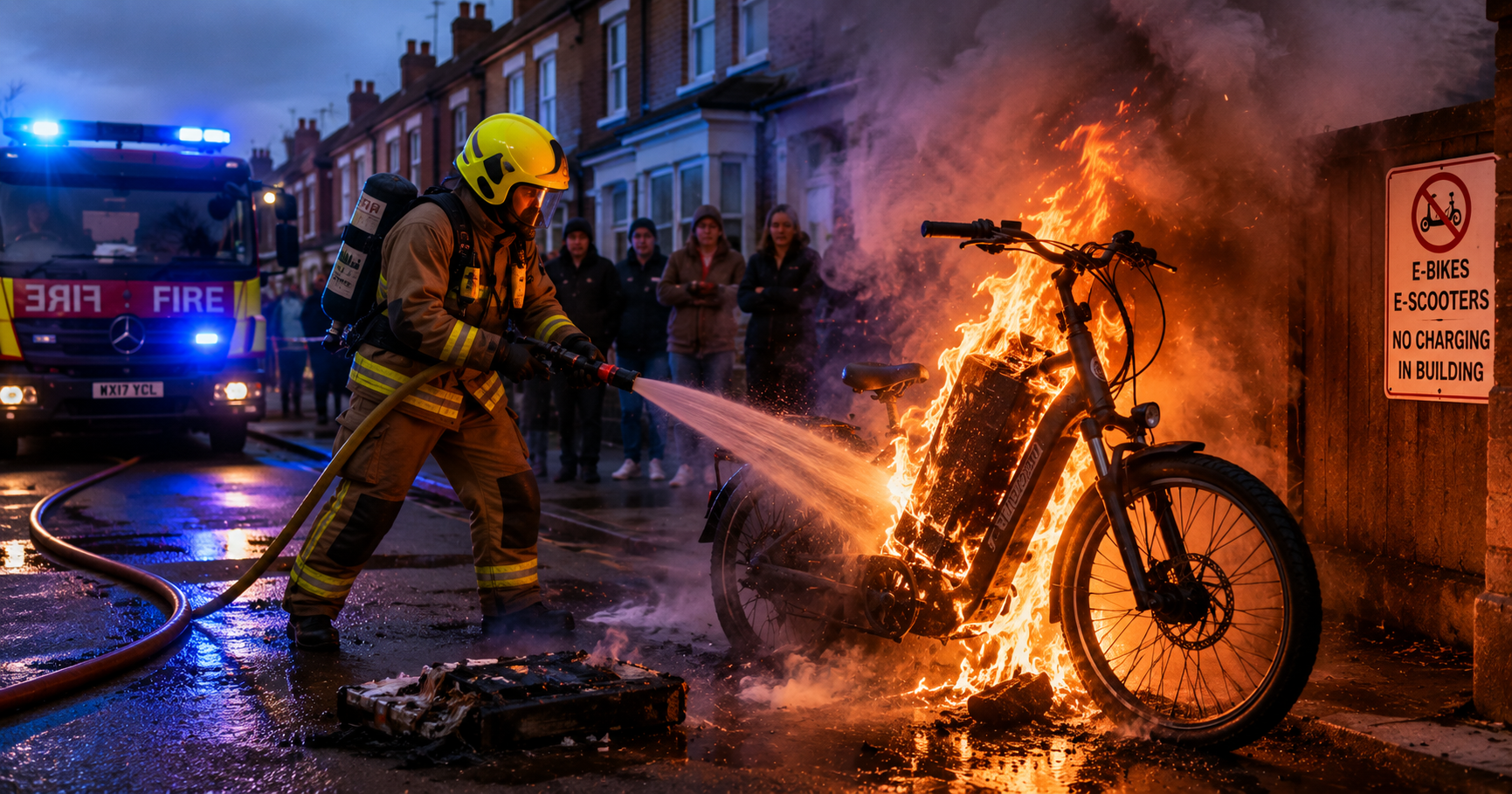
Recent data suggests that crews are now being dispatched to tackle battery-related infernos at a rate of nearly five per day, prompting calls for stricter safety regulations.
The scale of the problem was highlighted in new research from insurerQBE, which revealed that fire brigades in the UK are called 48.8lithium-ion battery firesevery day. This frequency marks a significant escalation in domestic fire risks, with the London Fire Brigade alone reporting 522 lithium-ion battery fires in 2025.
These fires are particularly dangerous because they involve 'thermal runaway', a process where a battery enters an uncontrollable, self-heating state. The blazes produce their own oxygen and release a toxic vapour cloud of hydrogen fluoride and carbon monoxide, making them incredibly difficult for standard extinguishers to suppress, according to theInternational Fire and Safety Journal.
Converted or retrofitted e-bikes and e-scooters—often purchased from unregulated online marketplaces—were involved in fires more frequently than officially manufactured models.
Many of these incidents occur while the devices are charging, particularly when owners use incompatible or aftermarket chargers that lack proper voltage cut-off safety features.
TheIndependentreports that a significant number of fires are linked to DIY conversion kits in which standard bicycles are fitted with battery-powered motors. These kits often lack the rigorous testing found in factory-built models—leading to catastrophic failure when the cells are damaged or overcharged.
Despite declining, the number ofdisposable vapesposes a fire hazard in the UK's waste management system. The batteries found in vapes can be crushed by compacting machinery when thrown into general household bins or recycling lorries.
The ensuing mechanical damage often triggers sparks that ignite surrounding rubbish, leading to massive fires at recycling centres that can burn for days and require over a dozen crews to extinguish.
Local authorities have urged the public to use dedicated battery recycling points to mitigate this invisible threat to the nation's infrastructure.
The danger was laid bare when a fire broke out in a ground-floor vape shop on Glasgow's Union Street, causing severe damage to the historic, B-listed Victorian Forsyth Building. The incident triggered a multi-agency emergency response and forced the complete closure of Glasgow Central station—Scotland's busiest rail hub—for two weeks, disrupting travel for thousands of commuters.
Source: International Business Times UK
