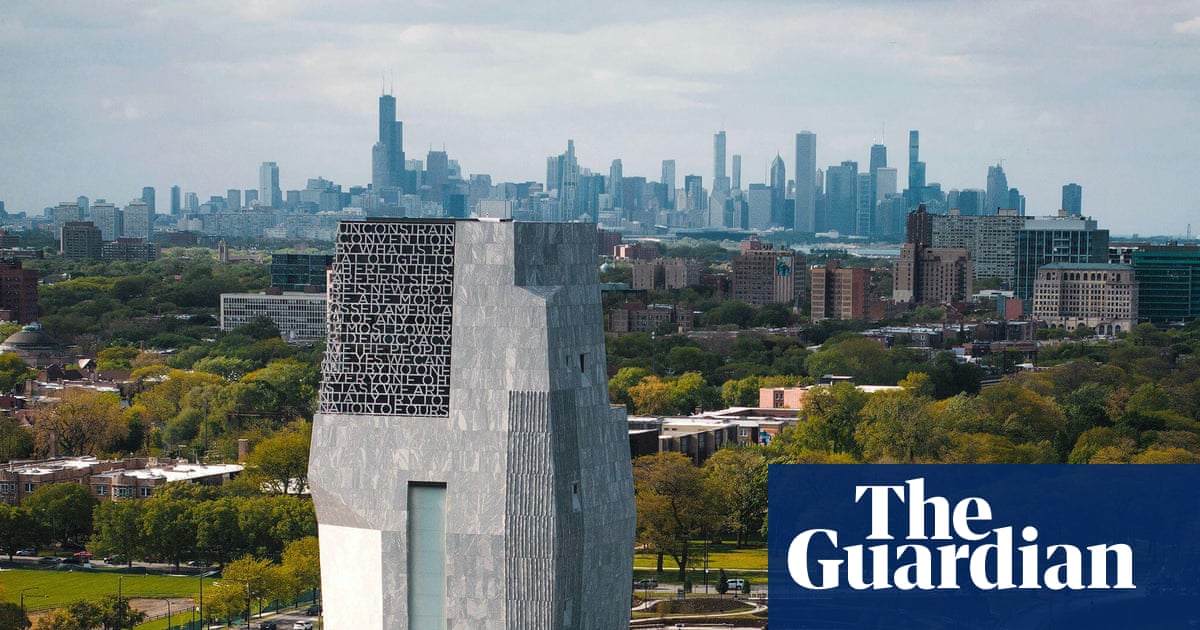
Towering over a low-income area of Chicago, and wrapped in a speech that’s hard to decipher, this controversial monolith feels like a menacing sci-fi HQ. Is it a monument – or a mausoleum?
The Egyptians had their pyramids. The Anglo-Saxons had their barrows. And the Americans have their presidential libraries – the chief difference being that the leaders the US venerates are usually still alive at the opening.
Lacking a royal family or a state religion, the US presidency has swelled to fill the void, transforming over the decades into a national personality cult, complete with its own secular temples to these powerful men. The latest pharaonic edifice is about to open on Chicago’s south side, where it looms on the skyline as atowering totem to the 44th president, Barack Obama. He might have seemed humble in office, but in his post-presidential, Netflix-producing afterlife, Obama has erected the largest, costliest and most audacious complex of them all. Behold the $850m Obamalisk – or, as it sometimes feels morbidly like, the Obamausoleum.
Previous presidential libraries have taken many forms, reflecting the values of their creators. Franklin D Roosevelt began the tradition in 1940,building a library in Dutch colonial stylealongside his grave in upstate New York, which he hoped would be swarmed with “an appalling number of sightseers”. Since then, every president has followed suit in their quest for immortality, dreaming up ever larger museums and archives, conceived as hallowed places of pilgrimage. Lyndon B Johnsoncommissioned a brutalist hulk for Austin, Texas, a fitting symbol, its architect Gordon Bunshaft remarked, for “an aggressive … big man”. Ronald Reagan opted for asprawling California hacienda, with a dedicated hangar for Air Force One, while Bill Clinton conjured acantilevered metallic box in Arkansas– a literal interpretation of his promise to “build a bridge to the 21st century”.
So, how to symbolise hope, justice, equality and all the other bygone values that Obama championed in his meteoric ascent to the White House? How to commemorate the first Black president in history, in whom so much transformational faith was vested, at a time when so many of his achievements are being relentlessly rolled back?
“We had the idea of a beacon,” says architect Billie Tsien, whose practice, Tod Williams Billie Tsien Architects,won the design competition for the Obama Presidential Center in 2016, on the eve of the first Trump presidency. “We thought of four hands coming together,” she adds, holding her cupped hands up against a colleague’s, as if protecting a flame from the wind.
Above us, sheer walls of granite erupt from the ground at a steep angle, before tapering to form a chiselled 70-metre-high monolith. It looks hewn and cleft, towering over the 19-acre campus like a stocky, truncated obelisk. Rising above the low-rise, low-income neighbourhood, the building has an ominous presence, its mostly windowless heft recalling a menacing sci-fi headquarters, with small chamfered openings suggesting portals from where drones might be launched, or lasers fired. Some have compared it to a flak tower,others to a “Klingon prison”. If it is a beacon of hope, it seems to be one that has been fortified at all costs against the present regime, a defensive bunker to protect its fragile values from siege.
“The president was very, very hands on with the design,” says Tsien, with a rueful air. “He talked a lot about his love of Brâncuși.” That’s the Romanian sculptor who was known for his carved, abstract forms. “And he wanted to make things more angular and cut. To make a form, and then try to work out what goes inside it, is really the opposite of how we’ve worked before. It was a very foreign exercise.”
Obama has spoken of wanting to be an architect, before he chose law, and he clearly relished the chance to wield his conceptual chisel. “When you have a client who says that, you get kind of uncomfortable,” admits Tsien. “It usually means they’ve got big opinions, and he definitely had big opinions. But he was a very good critic.” She says the Obama Foundation, which runs the centre, “wanted something ‘iconic’ which isn’t how we’ve worked before. I don’t think you can design something to be iconic.” Her face falls when we encounter3D-printed plastic models of the building for sale in the gift shop, priced at $40. Still, the client got what it wanted: this memorable menhir won’t be mistaken for anything else on your mantelpiece.
In the reluctant search for an icon, inspiration also came from a rock that Tsien and Williams acquired on a trip to Ethiopia, of a similar faceted shape to the building, with letterforms carved across its surface. Given that Obama was one of the finest presidential orators since Lincoln, it only seemed fitting to wrap the facade with his words. The lines, from his speech commemorating the 50th anniversary of the marches from Selma to Montgomery, now form asun-shading screen at the top of the tower’s south-west corner. “YOU ARE AMERICA,” you can just about make out, before the words dissolve into an illegible sea of letters. “I don’t know why it’s in Latin,” one confused local resident told me. The lorem ipsum vibes are real.
Source: Drudge Report
