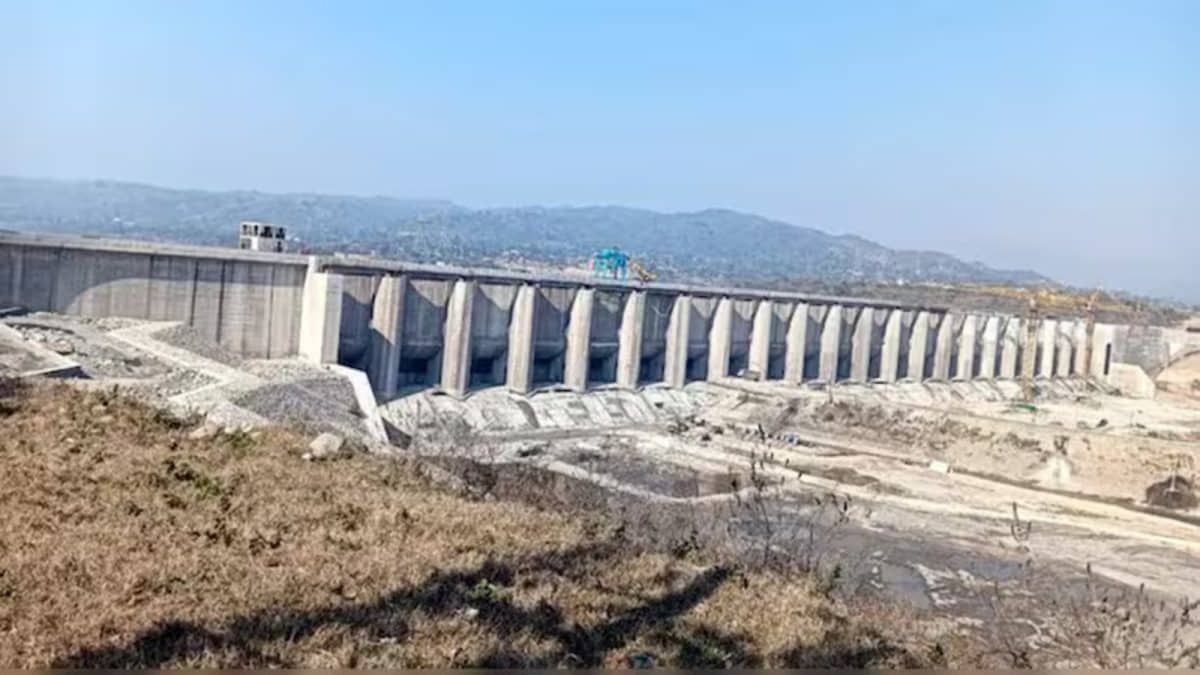
Pakistan’s water problems are expected to intensify. Already struggling with the suspension of the Indus Waters Treaty, Pakistan now faces another challenge as India plans to block the surplus water flow from the Ravi River as the delayed Shahpur Kandi dam on the Jammu and Kashmir–Punjab border heads for completion by March 31.
Over the years, the excess water from the Ravi used to reach Pakistan due to inadequate storage facilities on the Indian side. However, this is now set to change from April, further squeezing the water flow to Pakistan.
The fast-tracked revival of the Shahpur Kandi dam project holds great geopolitical significance and marks a decisive shift as it comes in the aftermath of the Pahalgam terror attack, which New Delhi squarely blames on Pakistan-backed terrorism. However, Islamabad continues to deny its involvement.
The project signals India’s intent to fully utilise its legitimate share of eastern river waters and end the routine flow of surplus Ravi water into Pakistan, worsening its water crisis.
Jammu and Kashmir water resources minister Javed Ahmed Rana made the government’s position explicit. “Yes, excess water (from Ravi river) to Pakistan will be stopped. It has to be stopped," he said, adding that the project is critical for drought-hit Kathua and Samba districts. “Kathua and Samba districts are drought-hit areas; and this project, which is our priority, is being constructed for the Kandi area."
The push gained momentum after the April 22 Pahalgam terror attack in Baisaran valley that killed 25 tourists and a local guide. Following the attack, Prime Minister Narendra Modi announced punitive measures against Islamabad, including suspension of the Indus Waters Treaty, a pact India has long argued Pakistan abuses while continuing hostile actions.
Under the treaty, brokered by the World Bank, the eastern rivers Ravi, Beas and Sutlej were allocated to India, while Pakistan received the western rivers Indus, Jhelum and Chenab, with India allowed limited, non-consumptive use of the latter. Despite this, large volumes of Ravi water have continued to flow downstream into Pakistan due to unfinished infrastructure on the Indian side.
The Shahpur Kandi barrage, now a national project, was revived after four decades following Modi’s intervention. On December 6, 2018, the Union cabinet approved its implementation, granting central assistance of ₹485.38 crore for the irrigation component. Once completed, the project will create irrigation potential for 5,000 hectares in Punjab and 32,173 hectares in Jammu and Kashmir’s Kathua and Samba districts. It will also help regulate irrigation water for 1.18 lakh hectares in Punjab and enable the state to generate 206 MW of hydropower.
Implementation of the project with Punjab will minimise the wastage of Ravi waters that currently flow past the Madhopur Headworks into Pakistan, a long-standing anomaly India is now correcting. In parallel, New Delhi has accelerated work on four hydel power projects on the Chenab river in Jammu and Kashmir, expected to be commissioned by 2027–28.
The Shahpur Kandi project’s troubled history underscores years of delay. A bilateral agreement between Punjab and Jammu and Kashmir was signed in 1979, with Punjab tasked to construct both the Ranjit Sagar Dam and Shahpur Kandi. Although approved by the Planning Commission in 2001 and declared a national project in 2008, progress stalled due to funding constraints and inter-state disputes. The foundation stone was laid in 1995 by then prime minister P V Narasimha Rao, but nearly 80 km of the Ravi canal and over 492 km of distribution network in Jammu and Kashmir lay unused for years.
Source: World News in news18.com, World Latest News, World News
