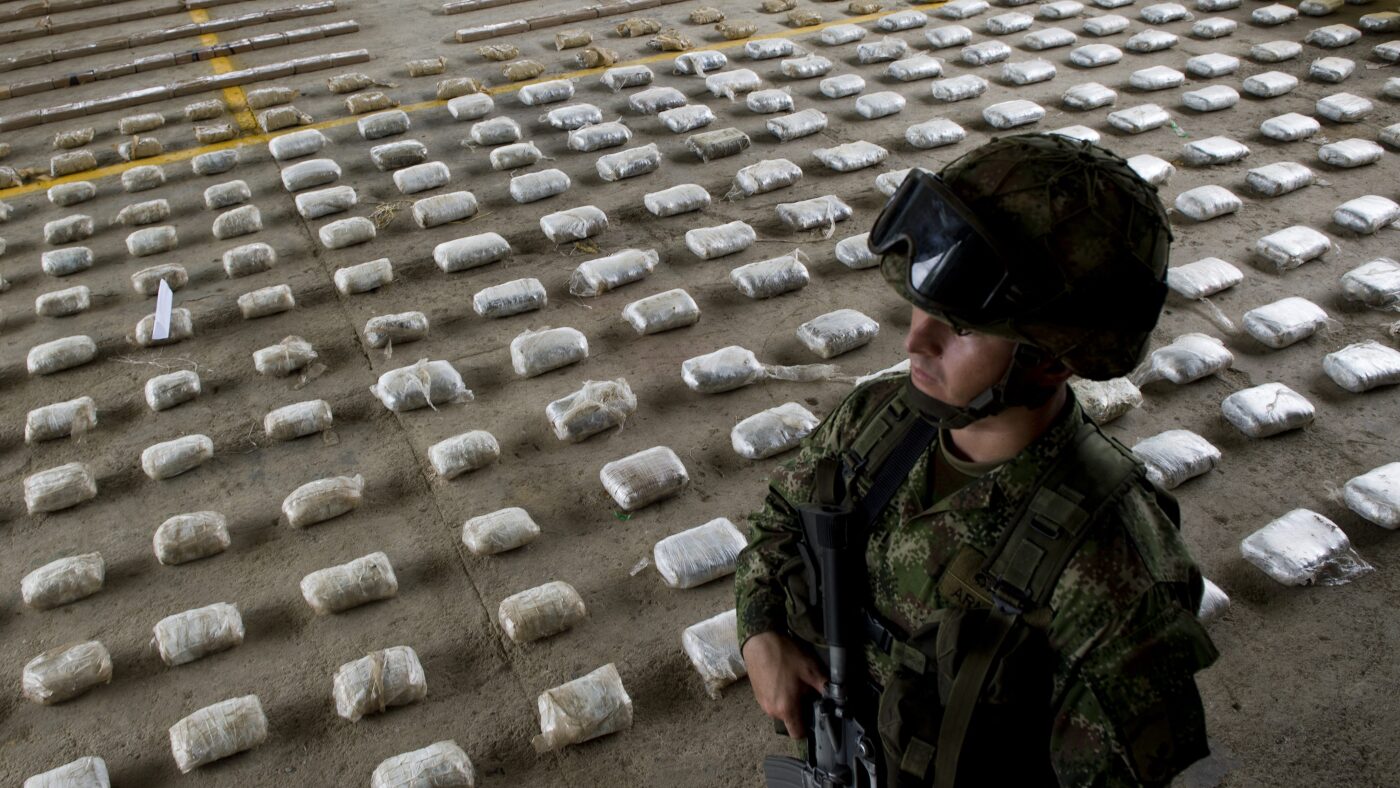
A Colombian Army soldier stands next to packages of seized cocaine during a press conference at a Military Base in Bahia Solano, department of Choco, Colombia, on March 14, 2015.LUIS ROBAYO/AFP via Getty Imageshide caption
A few weeks ago, a police officer made a routine traffic stop in Upland, California, just outside of Los Angeles. The officer was accompanied by a police dog named Petey.
As they approached the car, Petey began barking. Something about this car was clearly strange. Sure enough, they discovered that the vehicle had about 66 pounds of cocaine stashed in a hidden compartment.
"Drugs off the street, smuggler went to jail, and our good boy got a steak,"the Upland Police Department postedabout the drug bust on social media.
Drug busts like these are mounting around the nation, but they are just a small fraction of what's estimated to be a record-breaking surge in the supply of cocaine. In their most recent annual World Report, the United Nations Office of Drugs and Crimefoundthat, after a decade of rapid growth, "Global cocaine production has hit an all-time high once again, accompanied by significant increases in cocaine seizures, cocaine users and – most tragically – cocaine-related deaths in many countries."
So what's behind this surge? And how is it affecting us in the United States? Anew working paperfrom economists Xinming Du, Benjamin Hansen, Shan Zhang, and Eric Zou — "Coca's Return and the American Overdose Fallout" — has some answers.
A decade ago, it seemed like the heyday of the cocaine market was mostly behind us. The drug was still popular in certain places, but it was also something of a relic, associated more with discos in the 1970s and Wall Street in the 1980s.
Du and the other economists suggest that at least part of cocaine's decline was the result of fierce supply-side interventions in Colombia. With significant U.S. involvement, Colombia "waged an aggressive campaign against the plantation of coca, the raw plant used to make cocaine," they write. As a result, "Colombia's coca fields shrank from about 168,000 hectares in 2000 to just 48,000 by 2013, and cocaine became much less available in the United States."
TOPSHOT - A Colombian police officer hugs a dog during an operation to eradicate illicit crops in Tumaco, Narino Department, Colombia on December 30, 2020.JUAN BARRETO/AFP via Getty Imageshide caption
But around 2015, the economists write, a couple of policy changes "created a perfect storm for coca's resurgence." First, the Colombian governmentendedits U.S.-supported aerial fumigation program on public health grounds. Many feared that the chemical they sprayed (glyphosate) was carcinogenic. Then, in late 2016, the Colombian government signed a historic peace deal with the Marxist revolutionary guerilla group FARC. For decades, FARC had tried to overthrow the Colombian government, and to finance their war, they got heavily involved in the cocaine trade.
Source: Drudge Report