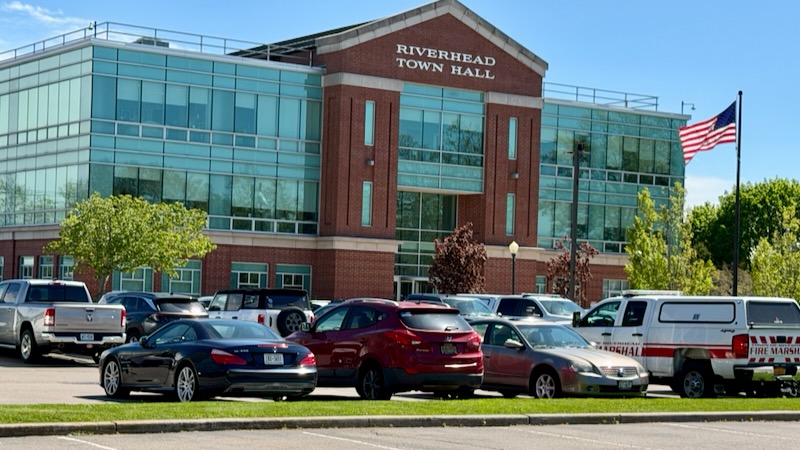
Riverhead Town Board members Thursday questioned the financial details and process behind Supervisor Jerry Halpin’s proposed early retirement incentive, after Halpin brought the proposal to a public work session for the first time following two prior executive session discussions and a social media announcement and press release earlier this week.
The proposal, still in conceptual form, would offer early retirement incentives to eligible CSEA, PBA and SOA employees. Town Financial Administrator Jeannette DiPaola said the idea was explored after the town completed its 2025 annual financial report and found the general fund had a $5 million surplus due largely to higher-than-projected interest earnings on investments.
“I have to admit, at first I was skeptical, because I’m very conservative and don’t really want to let go of any money,” DiPaola said. “But I was asked to put the numbers together on paper, and when we did,” she said, the potential savings became clearer.
Council Member Ken Rothwell questioned why the interest earnings weren’t used to reduce the 2026 budget and tax levy.
“Because we never know. Interest can change tomorrow,” DiPaola said. “When I look back at how we budgeted for interest, we’ve always budgeted conservatively, because the market can tank,” she said. DiPaola pointed to 2020 as an example. “We barely earned any interest in 2020… And now, because the [interest] rates are still so high, we’re earning a lot more money,” she said.
Budgeting for interest earnings in advance is “a judgment call,” DiPaola told the board, noting that overly optimistic revenue projections can be dangerous. If the projections are off-base, she said, “you’re kind of screwing yourself over and have to find that money at the end of the year.” For that reason, the town has historically projected interest revenues conservatively, she said.
DiPaola continued her presentation of the proposal. The early retirement incentive proposal is based on eligible employees who could retire without penalty, she said. For police officers, that generally means 20 years of service in New York law enforcement. For CSEA employees, the analysis used employees eligible for full retirement: age 55 with 30 years of service, age 60 with 25 years of service, or age 65 with 20 years of service.
DiPaola presented examples showing potential savings from replacing higher-paid employees with lower-paid new hires and moving employees from higher-cost retirement tiers to lower-cost tiers.
For a top-salary police officer, DiPaola said the town could save about $96,000 in salary, longevity and retirement costs, after accounting for additional retiree health insurance costs. She said the savings would vary by position, dropping to about $22,000 for a detective grade one, about $19,000 for a sergeant and about $17,000 for a lieutenant.
If every eligible PBA and SOA employee accepted an incentive, DiPaola estimated total savings at about $1.3 million to $1.4 million in the first year. She said the town currently has about $33.4 million in fund balance.
Source: RiverheadLOCAL
