Home-ORNL’s AI-Powered System Fixes 3D Printing Errors in Real Time
Scientists atOak Ridge National Laboratory(ORNL) have developed an automated control system that monitors and corrects errors during large-scale plastic 3D printing as they happen, no human intervention required. The development could give U.S. manufacturers a meaningful edge in producing large, customized parts with less waste and lower production costs.
Industrial-scale 3D printing works by pushing heated plastic composite through a robotic nozzle, building up layers to form massive objects like building panels, aircraft components, or automotive parts. The challenge lies in keeping each layer at just the right temperature, warm enough to bond to the one below, yet cool enough to hold its form. Traditionally, workers had to watch over this balancing act constantly.
Cameras That Think: How the System Works
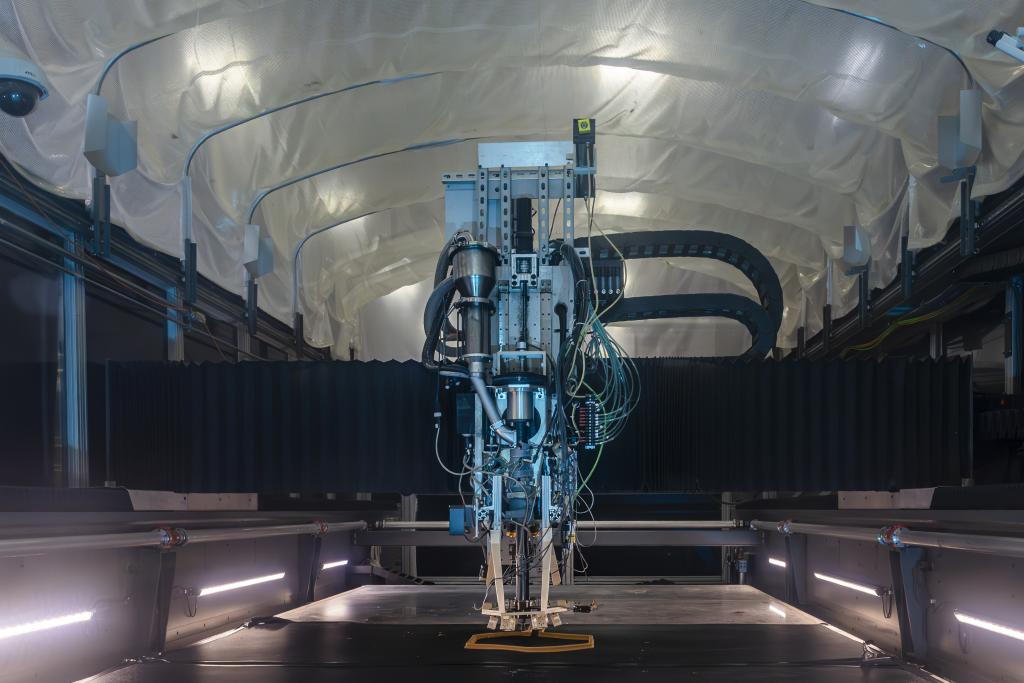
The ORNL team addressed this by building a controller packed with sensors that track nozzle position, printing speed, and material temperature. They added a ring of affordable thermal cameras mounted directly around the nozzle to continuously measure how quickly the deposited plastic cools.
Using computer vision, an AI technique that allows machines to interpret visual data, the controller analyzes a live thermal feed to pinpoint where the material is and how hot it is at any given moment. When it detects a temperature drift, it automatically adjusts the print speed so each layer reaches the ideal temperature before the next one is laid down.
“It is novel that our controller can sense what is happening and react in real time,” said Kris Villez, the project’s lead researcher, who partnered withUniversity of Tennesseegraduate student Chris O’Brien. “It controls the process almost like a human would: by observing and nudging the setting until it reaches the desired outcome.”
To validate the system, the team printed a hexagon larger than a truck tire. The test began deliberately slow, a condition that caused the plastic to arrive about 30% too cold for proper layer adhesion. The controller caught the problem and increased the print speed automatically, bringing temperatures back into the optimal range in real time.
According to O’Brien, the system can detect temperature shifts of just a few degrees, a level of sensitivity that matters because even minor thermal variation is enough to ruin a finished part. Crucially, the controller doesn’t need to be retrained for each new design or material, making it broadly compatible with different printers, plastics, and part geometries. The team also built a machine-learning-based digital twin, enabling safe experimentation with new shapes and materials before committing to a physical run.
What Comes Next for Smart Manufacturing
Source: 3D Printing Industry
