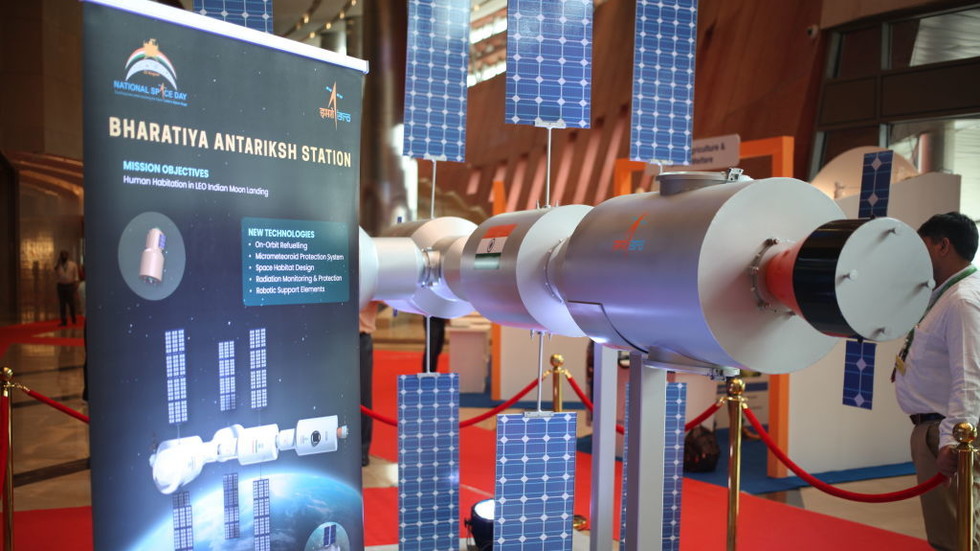
India's space agency ISRO has officially greenlit the next phase of its Bharatiya Antariksh Station (BAS) project, signaling a major leap in the nation's cosmic ambitions. Speaking at a press conference in Bengaluru, ISRO Chairman V. Narayanan revealed that engineering designs are advancing rapidly, with the first modules slated for launch by 2028. The announcement comes amid heightened global competition in low-Earth orbit infrastructure, positioning India as a serious contender alongside established players like NASA and Roscosmos.
The BAS, envisioned as a 20-tonne modular outpost orbiting at 400 kilometers altitude, will support three astronauts for missions lasting up to 15-20 days initially. Key milestones include the successful test of a propellant-efficient propulsion system earlier this year and partnerships with private firms for habitat modules. Narayanan emphasized self-reliance, noting that over 90% of components will be domestically sourced, reducing costs estimated at $1.5 billion over the next decade—a fraction of the International Space Station's price tag.
This push builds on India's string of recent triumphs, from the Chandrayaan-3 lunar south pole landing to the Aditya-L1 solar observatory. The Gaganyaan human spaceflight program, targeting crewed orbits by 2025, serves as a crucial precursor, providing vital data on life support and re-entry technologies. Government funding has surged, with Prime Minister Narendra Modi's administration allocating an additional ₹12,000 crore in the latest budget to fuel these endeavors.
Geopolitically, the BAS project underscores India's strategy to assert technological sovereignty amid U.S.-China space tensions. While open to international collaboration—discussions with Japan and France are underway—New Delhi has firmly rejected involvement with the China-led International Lunar Research Station. Analysts see this as part of a broader "space nationalism" narrative, boosting domestic STEM education and inspiring youth in a country where space feats often eclipse earthly divides.
Challenges remain, including mastering rendezvous and docking maneuvers and ensuring radiation shielding for long-duration stays. Yet, with ISRO's track record of cost-effective innovation, experts predict the BAS could operationalize by 2035, potentially hosting experiments in microgravity manufacturing and Earth observation. As Narayanan put it, "India is not just reaching for the stars—we're building homes there."
