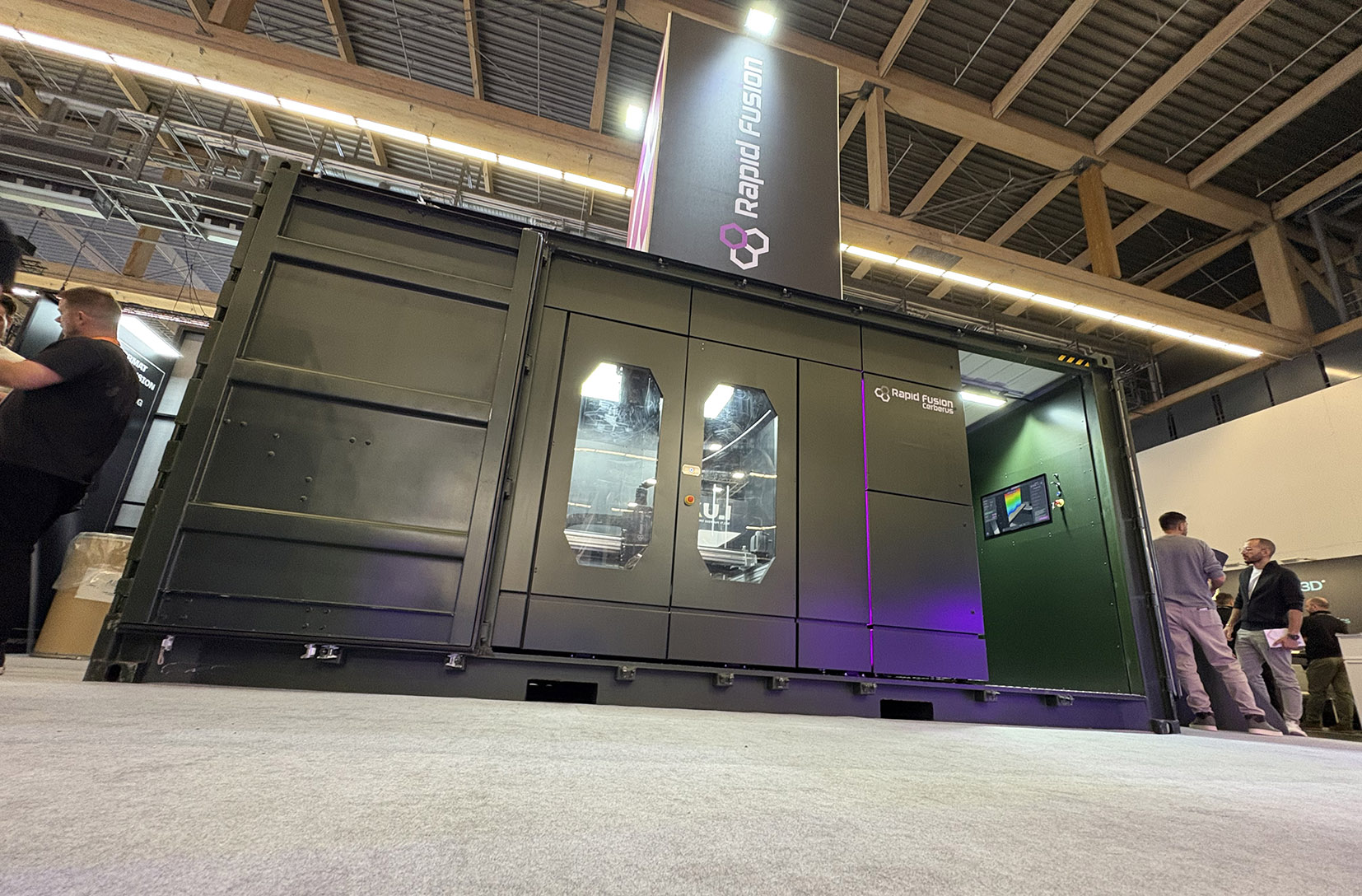
Exeter-based technology specialistRapid Fusionhas achieved a new milestone, exceeding £2 million in revenue for the first time in its three-year history. The company, operating from a £750,000 advanced demonstration facility at Sky Park, has seen increasing demand for its large-format additive manufacturing systems, with domestic and international orders for its Apollo, Zeus, and Medusa product lines.
The company’s growth reflects a focus on practical, application-driven 3D printing. Founder Jake Hand explained that Rapid Fusion prioritizes solutions that create functional manufacturing parts rather than experimental, one-off prints.
“There has been a lot of disruptors entering the 3D printing world and promising to print lots of one-off, unrealistic products that don’t really make commercial sense. We’ve instead looked at how we build our solutions so they are 100% focused on creating usable manufacturing parts that will go into automotive, aerospace and, increasingly, into military and life-saving applications.”
Strong sales of the company’s core robotic systems—designed, developed, and built entirely in the UK—have provided the foundation for Rapid Fusion to accelerate the deployment of its latest innovation: Cerberus. The company plans to expand its engineering, design, and software teams with five new roles immediately, and four more by the end of 2026, supporting ongoing growth and technology rollout.
Cerberus: Deployable Manufacturing for Extreme Environments
Cerberus, unveiled at Formnext in November, is a containerized hybrid manufacturing system designed for rapid deployment and operation in challenging or remote locations. The system combines 3D printing and CNC machining capabilities, offering a build volume of 1,200mm³, pellet throughput of up to 17kg per hour, and 3kW of continuous spindle power.
Engineered for environments where resupply may take months rather than days, Cerberus supports a wide range of bulk materials, dual independent heads to prevent downtime, and operation at temperatures up to 500°C for advanced composites. Its container-native design includes a self-leveling system and automated start-up sequence, allowing full deployment in just 25 minutes.
Chief Technical Officer Martin Jewell highlighted the system’s versatility: “Parts can be made on our system for rescue drones, safety critical parts for oil and gas, vital medical equipment in disaster zones and replacement bits for vehicles operating in some of the most demanding terrains in the world.” The system’s flexibility and speed have sparked interest from organizations seeking early access, with discussions underway for dedicated manufacturing cells to scale production.
Rapid Fusion is also exploring additional manufacturing space to meet anticipated demand, reflecting the company’s ambition to capitalize on Cerberus’ potential across both domestic and international markets.
Scaling large-format robotic extrusion and hybrid manufacturing presents technical challenges related to thermal stability, deposition accuracy, and process repeatability, particularly when systems operate outside climate-controlled environments. Variations in ambient conditions, material feedstock, and substrate preparation can affect dimensional tolerances and mechanical performance, increasing the need for robust monitoring and compensation strategies. Material qualification remains another key constraint, especially for advanced composites and safety-critical applications, where certification workflows in aerospace, defense, and medical sectors require extensive testing, traceability, and process validation, potentially slowing broader adoption despite strong application potential.
Source: 3D Printing Industry
