Home-Bambu Lab Teases New 3D Printer A2L Ahead of June 1 Reveal
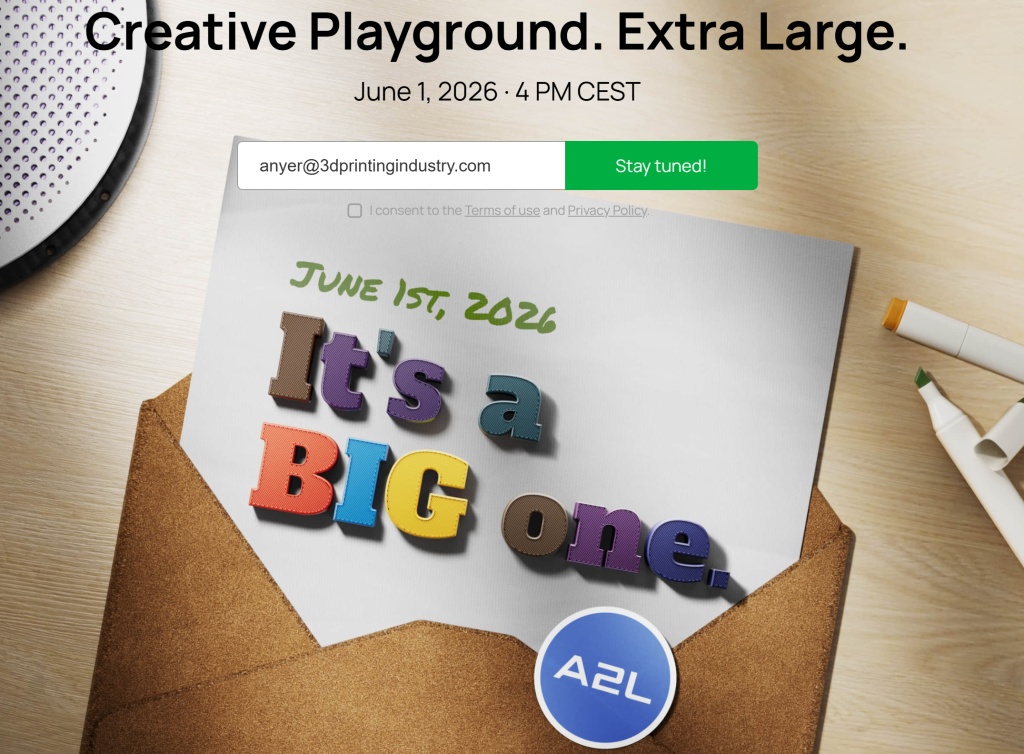
Desktop 3D printer manufacturerBambu Labpublished a teaser page for a new product called theA2L, scheduled for reveal on June 1, 2026, at 4 PM CEST. The page includes the tagline “Creative Playground. Extra Large” and the phrase “Stay tuned,” but does not list technical specifications, pricing, or availability.
The name places the teaser close to Bambu Lab’s A-series branding, though the company has not said whether it is an A1 successor, a larger A-series machine, or a separate product line. “Extra Large” has become the main clue in early discussion around the launch. That reading also fits a visible gap in Bambu Lab’s current range. The A1 offers a 256 × 256 × 256 mm³ build volume, while the H2S reaches 340 × 320 × 340 mm³ and is described by Bambu Lab as having the largest print space among its printers. A machine positioned between those systems would extend the company’s desktop range into a larger print envelope, though Bambu Lab has not confirmed any build volume for the A2L.
Discussion on Bambu Lab’sofficial forumhas quickly focused on a larger A-series machine and possible accessory functions. In the announcement thread, Mprints wrote, “By the look of it, it is like an A1 large and maybe with vortek? Or laser cutting?” kip speculated about a “350m3 bed” and “optional accessories to attach to tool head for cutting & drawing like the H2 series without laser.” Jaybo3178 suggested “a dual nozzle A1 but with H2 sized build plate,” while user_775130548 pointed to “the cutting (knive) and pen attachment.” abdbeg went a step further, writing, “There’s definitely cut knife attachment and probably something for multi color,” and Neiljt asked whether “the A1s [will] be put out to pasture” or remain aimed at novice users. Forum replies have largely clustered around a few recurring possibilities: a bigger A-series printer, craft-style cutting and drawing functions, and changes to Bambu Lab’s multicolor workflow.
Redditusers have been less aligned. One line of discussion has treated the teaser as a likely large-format bedslinger, with commenters debating the footprint and motion tradeoffs that could come with a bigger A-series machine. Another line has focused on demand rather than mechanics, with users arguing that many buyers would welcome a larger A1-style printer even if it remains simple and consumer-oriented. Some comments have also mirrored the forum’s focus on attachments, especially vinyl cutting and marker or pen tools. That split has made the broader community reaction notable in its own right: some users see A2L as a practical expansion of Bambu Lab’s entry-level range, while others are already questioning whether a larger open-frame machine would make technical sense.
Multicolor printing has also shaped the speculation because the A1 platform already supports the AMS Lite system. A larger A-series machine would raise practical questions about whether Bambu Lab plans to keep that external filament-handling setup, revise it, or continue reserving more advanced material and toolhead features for higher-end systems. None of those details appear on the teaser page. At this stage, Bambu Lab has not confirmed the A2L’s motion system, enclosure, build volume, extrusion setup, or accessory compatibility.
The June 1 reveal should clarify whether the A2L extends the A-series into a larger format, adds craft-oriented attachments to a consumer printer, or introduces a separate category within Bambu Lab’s desktop portfolio. Until then, the teaser has already done one thing effectively: it has turned a few words and a launch date into a lively debate across Bambu Lab’s own forum and the wider desktop 3D printing community.
Desktop 3D printing moves into more specialized territory
Recent launches show howcapabilities once tied to industrial composite systemsare moving into smaller, lower-cost hardware.FibreSeeker, a desktop 3D printer manufacturer founded by the original team behind composite printing specialistAnisoprint, recently introduced the FibreSeeker 3 at $2,699. The machine brings continuous fibre co-extrusion into a 300 × 300 × 245 mm desktop format, combining dual extruders, multi-material printing, and reinforced composite part production in a system aimed at workshops, classrooms, and small businesses. Its significance was not only technical. FibreSeeker’s launch showed that desktop manufacturers are no longer competing only on speed or ease of use. They are also trying to push more specialized performance into lower price bands.
A similar shift is visible further up the market, where manufacturers are compressingindustrial capability into more accessible systemsrather than leaving it inside six-figure platforms.Vision Miner, a manufacturer known for high-temperature industrial 3D printers, recently launched the 22 IDEX v4 at $14,900. That system combines a 350 × 350 × 450 mm build volume with 500 °C nozzles, a 100 °C heated chamber, and support for engineering polymers such as PEEK, PEKK, PEI, and PPSU. That matters here because it points to a widening middle of the market: machines are becoming more specialized by size, materials, or workflow without fully crossing into traditional industrial pricing. In that context, a larger or more feature-differentiated A-series system would fit a broader push to fill the gap between entry-level desktop printing and higher-cost production hardware.
Source: 3D Printing Industry
