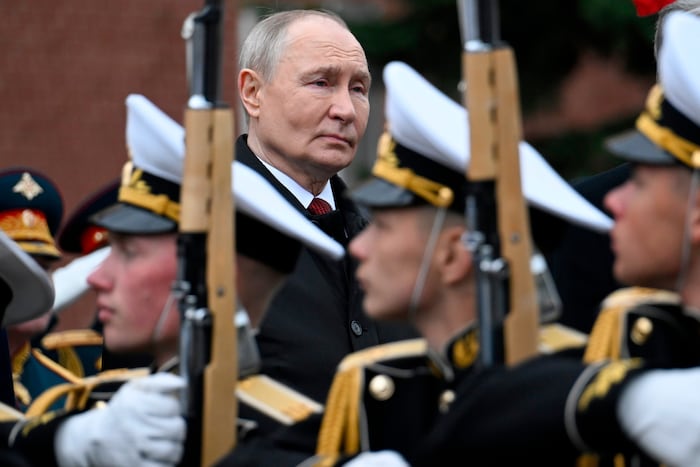
Facing a battlefield stalemate in Ukraine and growing war fatigue among Russians, President Vladimir Putin appears ready to try to change the narrative around the conflict.
He looks likely to sharply escalate the Russian aerial attacks on the Ukrainian capital in the hope it will shore up his sagging domestic approval ratings and persuade an increasingly pessimistic audience at home that Moscow is winning the war, now in its fifth year.
Russia’s warning to carry out “consistent and systematic” missile strikes on Kyiv, accompanied by a call for evacuating foreign embassies from the capital, signals Putin’s intention to expand Russia's barrage despite the heavy costs and potential international outrage.
Massive drills of Russia's nuclear forces earlier this month and a series of belligerent statements from Moscow warning Kyiv’s European allies about possible retaliation for what the Kremlin cast as their involvement in Ukrainian drone attacks have underlined Putin’s intention to up the ante.
As Russia's advance stalls, Ukraine boosts long-range strikes
After a series of gains last year, Russia’s advances along the over 1,000-kilometer (600-mile) front line have ground to a near halt recently, and Ukraine’s armed forces have launched successful counterstrikes and reclaimed some ground.
“The character of the war is shifting in favor of Ukrainian forces, at least for now,” the Washington-based Institute for the Study of War said in a recent analysis. “Russian forces’ rates of advances are stagnating while Ukrainian forces are employing novel tactics and operational concepts in efforts to break out of positional warfare.”
The battlefield gridlock undermines Putin’s declared goal of quickly capturing the eastern Donetsk region still under Ukrainian control. Kyiv has rejected his demands to withdraw from the region as a condition for a ceasefire.
At the same time, Ukraine has significantly expanded its long-range strikes on Russian energy facilities and arms factories, inflicting increasing damage.
Putin scaled down the annual May 9 Victory Day parade, fearing Ukrainian drone strikes. Days later, a massive drone attack on Moscow's suburbs killed three and showed that even the densely protected capital isn’t fully immune from assault, shattering Kremlin efforts to cast the conflict as something distant that doesn’t affect ordinary Russians.
Source: WPLG
