Home-A Hawaii Startup Is 3D Printing Military Boat Hulls From Basalt Fiber Composite
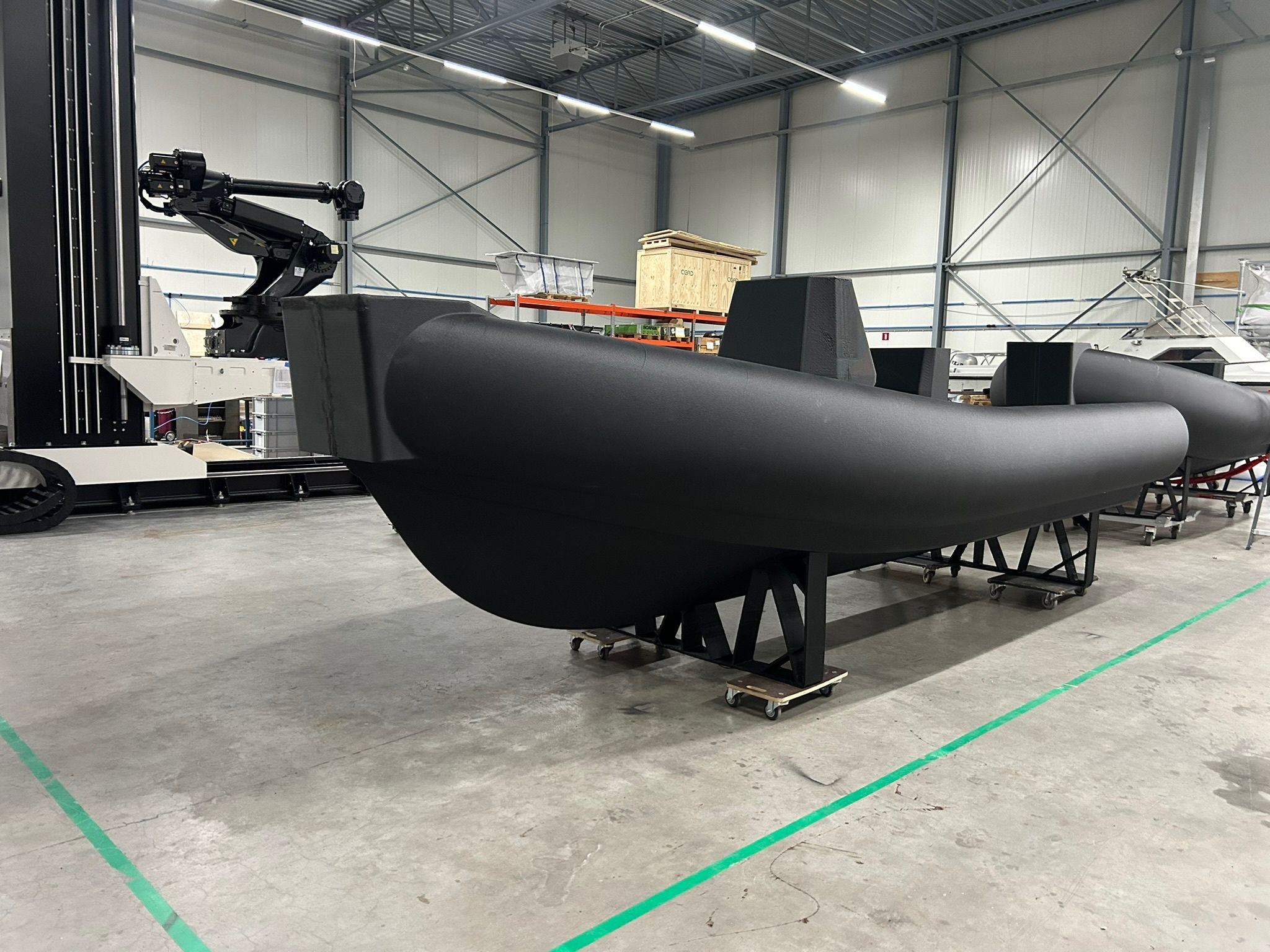
Voltage Vessels, a Hawaii-based startup founded by Sam Young, has submitted a six-meter 3D printed rigid hull inflatable boat for U.S. maritime defense evaluation, for potential integration into autonomous naval programs. The hull was printed using CEAD’s large-format additive manufacturing system, a Dutch industrial printer used by multiple defense contractors for hull-scale composite production.
The submission is the company’s first entry into formal defense evaluation. Voltage Vessels is building its case around two claims: that Eclipse X9 outperforms existing printed marine composites in structural and saltwater tests, and that hulls printed from digital files at regional facilities across the Indo-Pacific can replace the conventional model of manufacturing boats in fixed U.S. facilities and shipping them forward.
The Material: What Eclipse X9 Is and How It Has Been Tested
Eclipse X9 combines recycled PETG plastic with chopped basalt fiber, a volcanic mineral common in Hawaii, into a pellet and filament format designed for large-format additive manufacturing.
External testing at theUniversity of Maine’s Advanced Structures and Composites Centersupported the company’s performance claims. Testing under project ID UM-TC-23-1008 measured tensile strength at approximately 108 megapascals along the print direction and 36.5 megapascals perpendicular to layers, against 49.2 and 9.7 megapascals respectively for HDPro. Bending strength reached 112.98 megapascals in the primary direction versus 60.40 megapascals for wood-filled PETG. After 24 months of saltwater immersion, the material retained over 90 percent of its strength, with water absorption below 0.4 percent.
Beyond the Hull: RF Properties and the Distributed Manufacturing Bet
Basalt fiber’s electrical non-conductivity gives Eclipse X9 a low dielectric constant, it does not reflect radar energy or interfere with the RF signals that autonomous naval systems depend on for navigation, communication, and sensor operation. That is a practical advantage over aluminum and carbon fiber hulls, though RF transparency remains under evaluation for specific frequency ranges.
The manufacturing model carries the same logic further. Rather than shipping replacement hulls from continental U.S. facilities, Voltage Vessels is proposing regional production nodes across the Indo-Pacific, each printing hulls from digital files using locally compounded Eclipse X9. Production capacity is described as scalable to 15,000 metric tons annually.
3D Printed Hulls for Autonomous Naval Programs
Source: 3D Printing Industry
