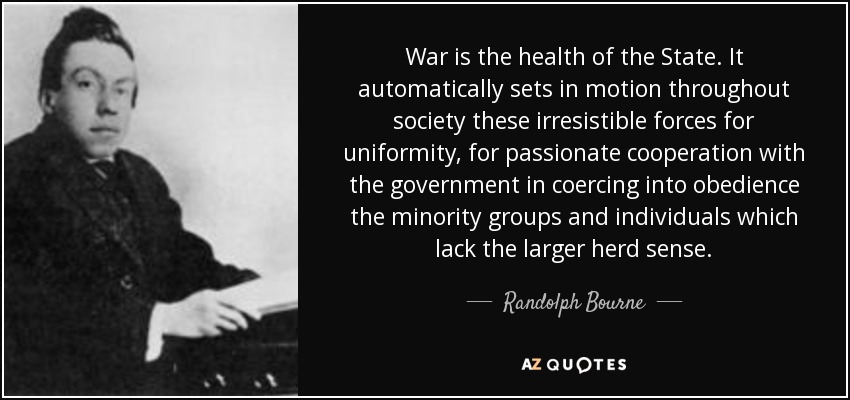
Saturday is the 140th anniversary of Randolph Bourne’s birthday. Antiwar.com named itsparent institutefor this early 20th century antiwar activist. Read Jeff Riggenbach’sbiographyof Bourne.
[Transcribed from theLibertarian Traditionpodcastepisode “Randolph Bourne (1886–1918)”]
Randolph Bourne was an American intellectual journalist who flourished for a few years in the second decade of the 20th century – in the Teens, the decade that ran from 1910 to 1920. Bourne wrote mostly for magazines during this period. His byline was particularly familiar to readers ofThe New Republic– until his radically antiwar views on the eve of the US government’s intervention in World War I got him fired.
He moved over toThe Seven Arts, a newly launched magazine with a smaller circulation thanThe New Republicand one less well suited to Bourne’s particular talents and interests, since its primary focus was the arts, rather than social and political issues. He was able to publish only six antiwar articles inThe Seven Artsbefore its doors were closed by an owner fearful of the Wilson administration and itsSedition Act of 1918, which made it a crime to criticize the Constitution, the government, the military, or the flag.
Only a few months afterThe Seven Artsceased publication, Randolph Bourne died, a victim of the flu epidemic that killed more than 25 million people in 1918 and 1919, nearly a million of them in the United States. That was 1 percent of the population 90 years ago. One percent of the present US population would be more than 3 million Americans. Imagine what it would be like to live through a flu epidemic that killed more than 3 million people in the space of little more than a year. That’s what it was like for Americans living 90 years ago, at the end of World War I.
Most of the people that flu virus killed have long been forgotten – except, of course, by members of their own families. But Randolph Bourne has not been forgotten, not completely. People are still reading his work. They’re still talking about his ideas and about his memorable phrases. The most famous of these has gradually become so widely quoted in our culture that millions of people have heard it, even heard it repeatedly, without ever learning who originally wrote or said it: “War is the health of the State.”
Randolph Silliman Bourne first emerged into the light of day on May 30, 1886 in Bloomfield, New Jersey, a small town fewer than 20 miles from Manhattan. His family was comfortably middle-class, and he was the grandson of a respected Congregational minister. But he seems to have been born unlucky all the same. First, his head and face were deformed at birth in a bungled forceps delivery. Then, at the age of four, after a battle with spinal tuberculosis, he became a hunchback. Then, when he was seven, his parents lost everything in thePanic of 1893, and he and his mother were abandoned by his father and left to live in genteel poverty on the charity of his mother’s prosperous (if somewhat tightfisted) brother. Meanwhile, his growth had been permanently stunted by the spinal tuberculosis of a few years before, so that by the time he graduated from high school at the age of 17, in 1903, he had attained his full adult height of five feet.
Bourne was an exemplary student. His academic record in high school earned him a place in the class of 1907 at Princeton, but by the time he was supposed to appear on campus to register for classes in the fall of 1903, it was evident that he couldn’t afford to attend. He could barely afford books. He was flat broke. And his mother needed his financial help if she was going to go on living the decent, middle-class lifestyle to which she had become accustomed. So Bourne postponed college and went to work. He knew his way around a piano, so for the next six years he worked as a piano teacher, a piano tuner, and a piano player (accompanying singers in a recording studio in Carnegie Hall). He also cut piano rolls. On the side he freelanced for book publishers as a proofreader. Now and then, when musical work was harder to find, he did secretarial work.
By 1909, when he was 23 years old, Bourne had saved enough to cut back on his working hours and try to catch up on the college experience he’d been putting off. He enrolled at Columbia, where he fell under the sway of historian and political scientistCharles Beardand philosopherJohn Dewey, and began publishing essays in theDial, theAtlantic Monthly, and other magazines. His first book,Youth and Life, a collection of his magazine essays, was published the year he graduated from Columbia, 1913. And that fall, the now 27-year-old Bourne set out for Europe. In his senior year he had been awarded the Gilder Fellowship for travel abroad, which the historian Louis Filler has called “Columbia’s most distinguished honor” during that period. Bourne spent a year travelling around Europe and pursuing such independent study as interested him.
Then, in August 1914, he returned to America, took up residence in Greenwich Village, and resumed writing for theDialand theAtlantic Monthly, along with a new, upstart weekly calledThe New Republic. Actually, it might be more accurate to say that BournefledEurope in August 1914 than to say that he merely “returned to America” at that time. For it was in late July and early August of 1914 that Europe – virtuallyallof Europe – embarked upon the conflict we know today as World War I. Bourne opposed this conflict, and he was especially worried that his own country, the United States, would choose to enter it before long.
Source: Antiwar.com
