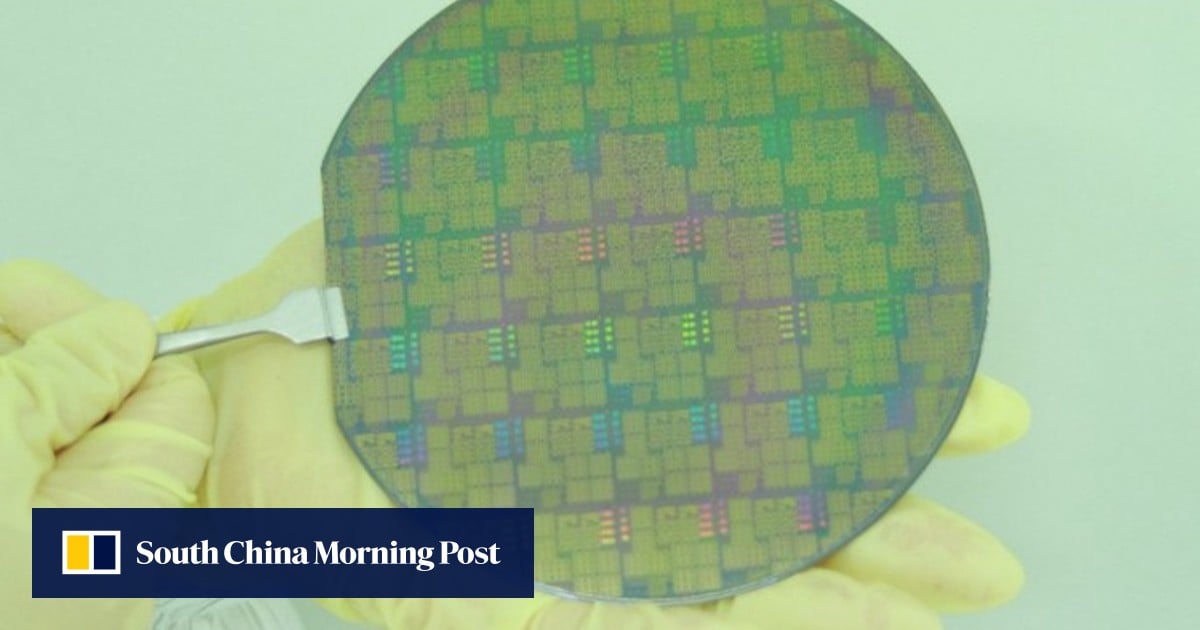
Marking a global first for 2D semiconductors, the new microprocessor overcomes silicon size limits to boost density and slash data delays
But two-dimensional materials such as molybdenum disulfide are naturally atom-thin, allowing electrons to move stably and efficiently and making them strong candidates to sustain Moore’s Law.
A team from Nanjing University’s School of Integrated Circuits, together with Huawei, created the first molybdenum disulfide-based multi-bit parallel microprocessor. Their work was published in Nature Electronics on Tuesday.
The device – called Mengqi-1000, or Magic-1000 in English – achieved record-breaking integration density, a measure of how many transistors can be packed onto a microchip.
Source: News - South China Morning Post
