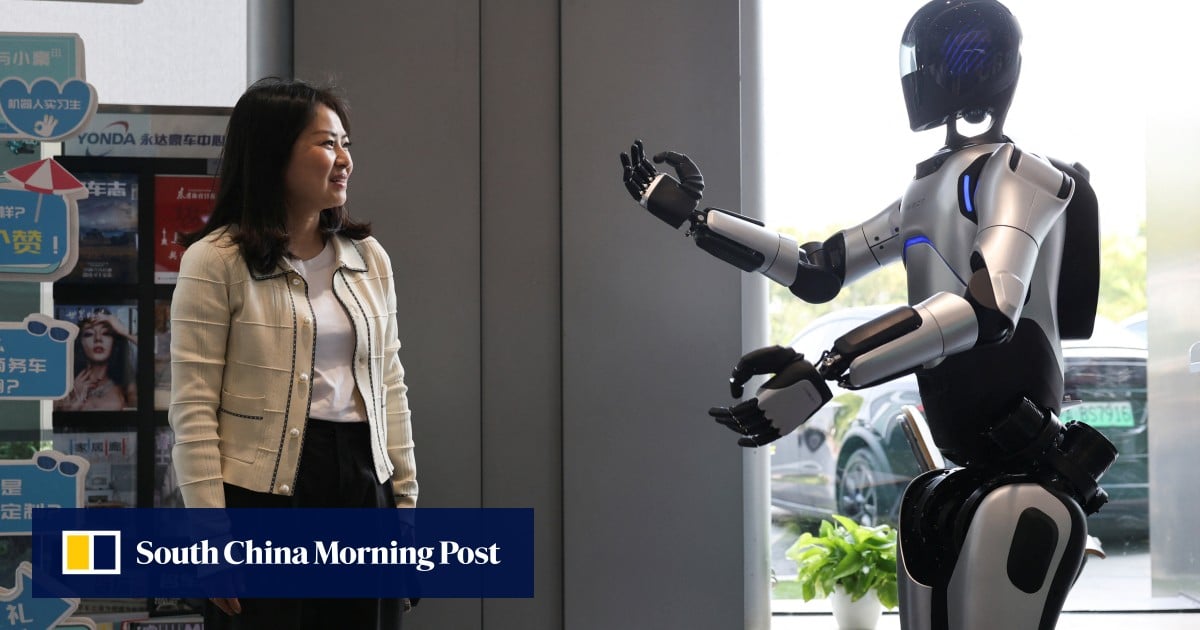
Embodied AI and autonomous agents are increasingly viewed by investors as one of the next major growth areas for the sector, UBS says
Chinese tech companies are racing to deploy artificial intelligence models into robots, shifting the battleground for generative AI from digital chatbots to physical autonomous systems.
Alibaba Group Holding’s Qwen3.7-Max model, launched last week, features “tool-calling” capabilities that allow the AI model to act as a digital brain to trigger external software and hardware components. The company said the model could be used to control robots by orchestrating physical actions like navigation, obstacle avoidance and task planning.
The tech giant has also released a suite of supporting AI models for robotics, including a robotic gripper agent, a navigation model and a vision-language system designed for physical-world interaction. Alibaba owns the South China Morning Post.
This comes after embodied AI start-up Zeroth announced earlier this month that its M1 humanoid had become the first mass-produced robot to integrate Tencent Holdings’ OpenClaw AI agent framework, allowing large language models to interpret human speech and immediately translate them into robotic movements.
The race to integrate AI software with robotics hardware underscores an evolution in AI development.
“The past few years of large language model development have mainly focused on solving problems in the digital world,” Wu Bangyi, chief data officer at Chinese tech company Tianyu Shuke, was quoted as saying by Securities Daily.
Source: News - South China Morning Post
