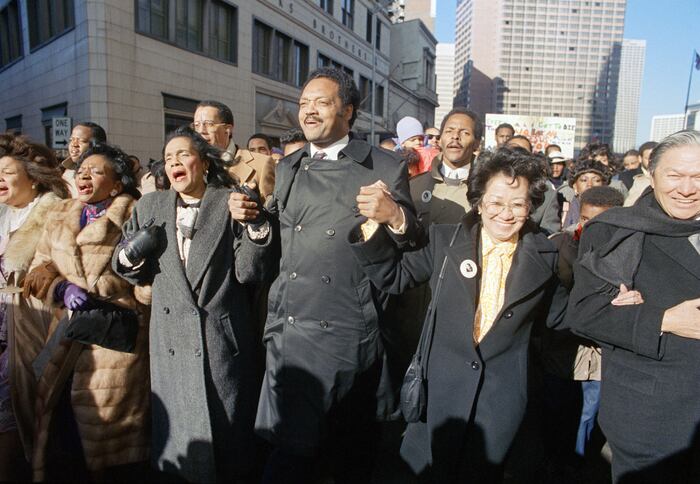
Many people who knew and worked with the Rev. Jesse L. Jackson Sr. are vowing to ‘keep hope alive’ in honor of his legacy. Jackson, who led the U.S. Civil Rights Movement for decades, died Tuesday. The protege of the Rev. Martin Luther King Jr. and two-time presidential candidate was 84.
Jackson led a lifetime of crusades in the United States and abroad, advocating for the poor and underrepresented on issues from voting rights and job opportunities to education and health care. He scored diplomatic victories with world leaders, and through his Rainbow/PUSH Coalition, he channeled cries for Black pride and self-determination into corporate boardrooms, pressuring executives to make America a more open and equitable society.
And when he declared, “I am Somebody,” in a poem he often repeated, he sought to reach people of all colors. “I may be poor, but I am Somebody; I may be young; but I am Somebody; I may be on welfare, but I am Somebody,” intoned America’s best-known civil rights activist since King.
Santita Jackson confirmed that her father died at home in Chicago, surrounded by family.
Neighbor wonders who could take on Jackson’s role
Dominique Ross has lived across from the Jackson home for nine years on Chicago’s South Side. She remembered Jackson for his open smile and welcoming attitude whether he was taking a walk or participating in the Bud Billiken Parade celebrating Black youth and community in Chicago each fall before the school year begins.
“I don’t know who will come up behind him, who will have as much of an impact as he has had on the Black community and just the world as a whole,” Ross said. “I mean, he’s an icon. They’re not going to make another man like him.”
Jackson’s neighbors in Chicago lament his passing
Harold Hall, who once lived in the neighborhood where Jackson’s home sits, slowly walked along the sidewalk and up the steps Tuesday morning to leave a small bouquet of flowers outside the Jackson family’s door.
Hall told reporters that Jackson helped local street organizations in the late 1960s and early 1970s. “Rev. Jackson was one of the ones that would come out and shoot ball and try to change the minds of many of our young folk,” Hall told reporters. “And in many instances, it happened. It worked.”
Source: WPLG
