Reprinted fromAndy Worthington’s website.
962 days since Israel’sgenocide in Gazabegan, and 227 days sincea ceasefire took effectthrough the implementation of the first phase of Donald Trump’s “Peace Plan”, Nickolay Mladenov, the Bulgarian former UN official who is now the “High Representative of Gaza” in Donald Trump’s “Board of Peace”, has alarmed those seeking a balance between Israel’s obligations under the ceasefire deal and an acceptable response by Hamas bytelling the UN Security Councilon May 21 that Hamas was the “principal obstacle” to the continued implementation of the next phase of the “Peace Plan” because “it refused to accept verified decommissioning, relinquish coercive control and allow a genuine civilian transition.”
Mladenov’s speech to the UN followed whatDrop Site News, on May 22, described as a “15-point roadmap” that he delivered to Hamas in April, which “amounted to an ultimatum: If the Palestinian resistance does not surrender its weapons, no meaningful reconstruction will be permitted in Gaza and Israeli forces will not withdraw.” In hisreportto the UN Security Council, Mladenov described the total disarmament of Hamas and other resistance groups as “the single factor that unlocks every other element of the plan.”
As Drop Site News proceeded to explain, however, “disarmament was categorically not a part of the phase one deal signed by Hamas and Israel in Sharm El-Sheikh, Egypt in October 2025.” As they added, “Despite repeated claims by US and Israeli officials that Hamas agreed to all of Trump’s terms, [they] and other Palestinian factions did not sign an agreement beyond a ceasefire, exchange of captives, and an initial framework for the redeployment or withdrawal of Israeli forces from some parts of Gaza.” The limited deal, they added, “also included the opening of the Rafah border crossing with Egypt and the resumption of deliveries of life essentials and equipment to clear rubble and begin early reconstruction efforts.”
Israel continues to block the promised amount of humanitarian aid to Gaza
Noticeably, however, the promised delivery of humanitarian aid at a scale appropriate to sustain the beleaguered population has manifestly not emerged. 600 trucks a day were promised, but, instead, only an average of 95 trucks a day have been allowed in. Similarly, although Israel belatedlyreopened the Rafah Crossingwith Egypt in February, to facilitate the departure of patients in need of urgent medical care, and the return of those seeking to come back home, the numbers allowed have, as with the humanitarian aid, fallen far short of what was promised, and over 18,500 patients, including 4,000 children, are still in need of urgent medical evacuation.
Similarly, hospitals and healthcare remain in a severe, Israeli-manufactured crisis. As OCHA (the UN Office for the Coordination of Humanitarian Affairs)reportedin February, “none of Gaza’s 37 hospitals were fully operational, and only 19 were even partially functioning”, and in March, as the WHO (World Health Organization)reported, “Israeli delays in approving specialized surgical equipment [were] limiting complex care, and at least 46 percent of essential medicines [were] out of stock.”
More recently, as the WHOreported, “An estimated 43,000 people of the 172,000 people injured in Gaza since October 2023 have sustained life-changing injuries”, one in four of them children, and more than 50,000 “require long-term rehabilitation.”
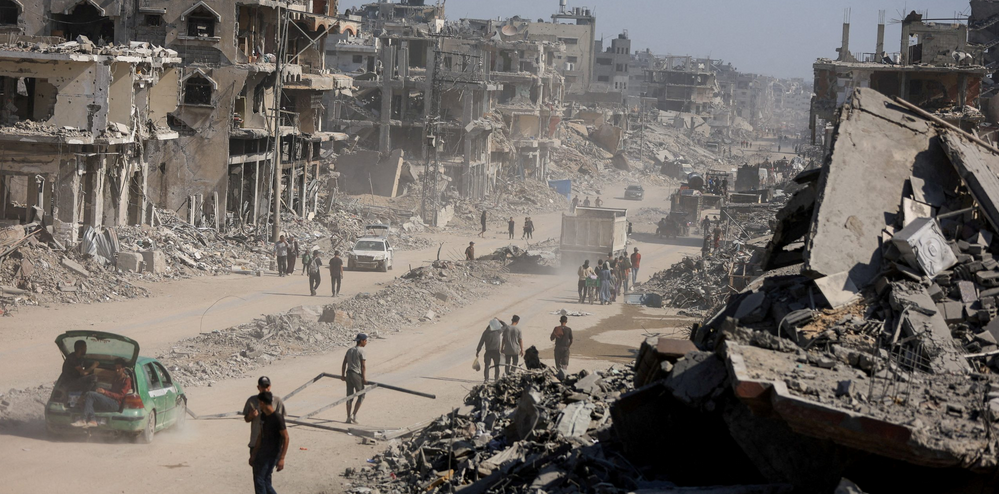
As Drop Site News described the current situation, “The ground reality in Gaza is now one of suspended catastrophe. While the dire famine conditions have largely receded as a minimal quantity of basic goods have become available, Israel continues to block the entry of a wide range of medical supplies, fuel, shelter as well as heavy equipment to clear the rubble,dig for remains, and start recovery efforts. Much of the Strip remains a wasteland of devastation with Palestinians living in tents and makeshift shelters, some of whichare infested with rats.”
Even that, however, seems to underestimate the gravity of the situation. In a report on May 19,Human Rights Watchwarned that the risk of famine was returning to Gaza, and Adam Coogle, the organization’s Middle East deputy director, was scathing about the promises of the “Peace Plan”stating, “The plan was supposed to bring relief. Instead, Palestinians in Gaza are still hungry, still cannot reach medical care, and civilians are still being killed. Whatever the Board of Peace tells the Security Council, that is what life looks like six months in.”
Source: Antiwar.com
