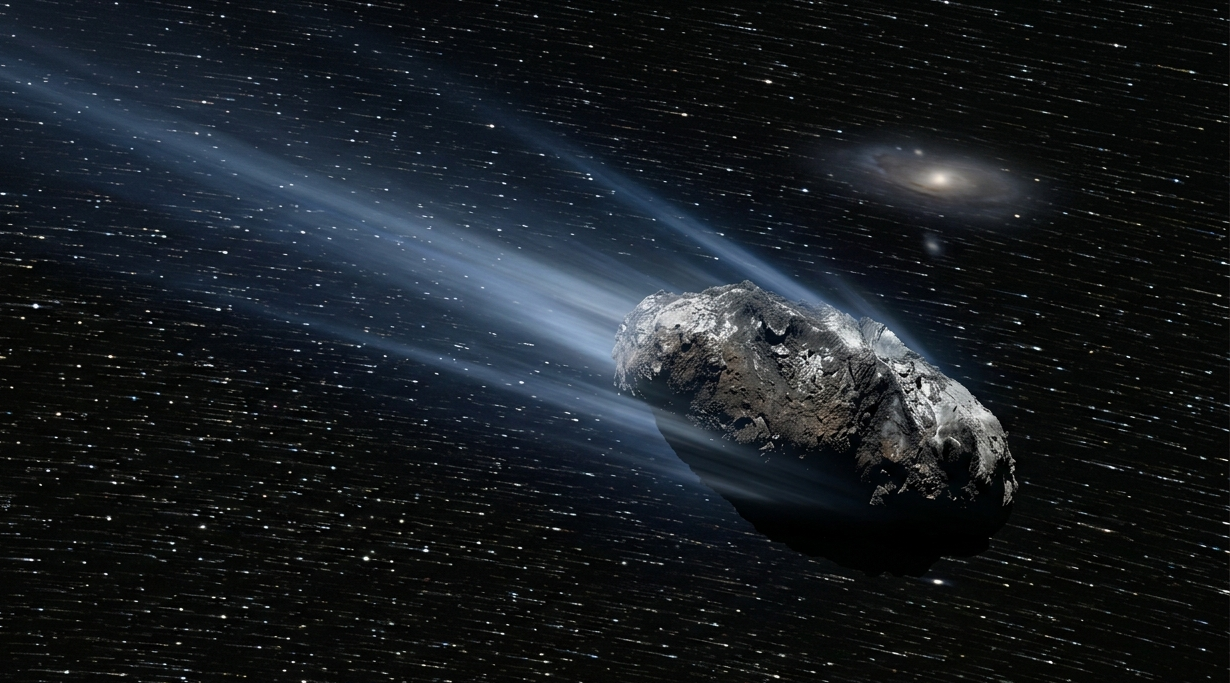
Rather than life starting independently on Earth, a fraction of the scientific community has spent years arguing that cosmic dust, comets, and asteroids act as interstellar delivery vehicles, carrying the essential building blocks of existence across the universe under a concept known as panspermia.
Even the legendary planetary scientist Carl Sagan toyed with an even wilder idea: that an intelligent alien race might have intentionally targeted far-off planets, sending out these cosmic seeds to kickstart life on purpose.
It is a fascinating but wild theory, and it is exactly what has been occupying Harvard astronomer Avi Loeb lately. After tracking the mysterious interstellar object3I/ATLASfor months as it skimmed past several of our planets last year, Loeb suggested the visitor might have been scattering the ingredients for life along its route—or that someone built it to do just that.
In his latestblog post, titled 'Did 3I/ATLAS Deliver Extrasolar Life to Our Backyard?,' Loeb explained how alien organisms could survive the deep-space voyage locked away inside the frozen pockets of the comet, only waking up as they pass close to worlds like ours. He painted a picture of the object acting just like a 'dandelion flower shedding itsseedsto be carried by wind towards a fertile ground.'
'In addition to natural origins, there is the possibility of directed panspermia, whereby an interstellar gardener seeded 3I/ATLAS on a fertilization mission targeting the habitable planets in the Solar System,' he wrote. 'This would explain the rare alignment between the trajectory of 3I/ATLAS and the orbital plane of the habitable planets around the Sun, as well as the sunward jet with large fragments that plowed through the solar radiation and wind.'
If the NSF-DOE Rubin observatory ends up finding more of these interstellar icebergs clustered mostly around the ecliptic plane, Loeb believes it will suddenly make the idea of directed panspermia look a lot more likely.
If that happens, Loeb believes that space agencies shouldn't just watch from afar, but launch a chase mission. He proposes intentionally crashing a probe straight into the iceberg's surface, kicking up a massive cloud of debris that could be analysed for signs of alien life.
The ultimate question, he suggests, is whether any discovered organisms resemble us. If they do, it opens up the mind-bending possibility that Earth was planted from the start by an interstellar gardener.
'This could be a fundamental discovery about our cosmic roots,' Loeb noted. 'Not only that life exists elsewhere, but interstellar gardeners may have seeded our existence.'
This isn't the first time Loeb has gone all in on a theory like this. He previously spent a long time trying to prove that 3I/ATLAS was actually an alien spacecraft sent to spy on us, an idea that most of his peers completely rejected. Even though piles of new data now practically prove the object is just a standard comet made of ice and rock, this latest blog post shows he isn't backing down and underscores his determination to keep the debate alive.
Source: International Business Times UK
