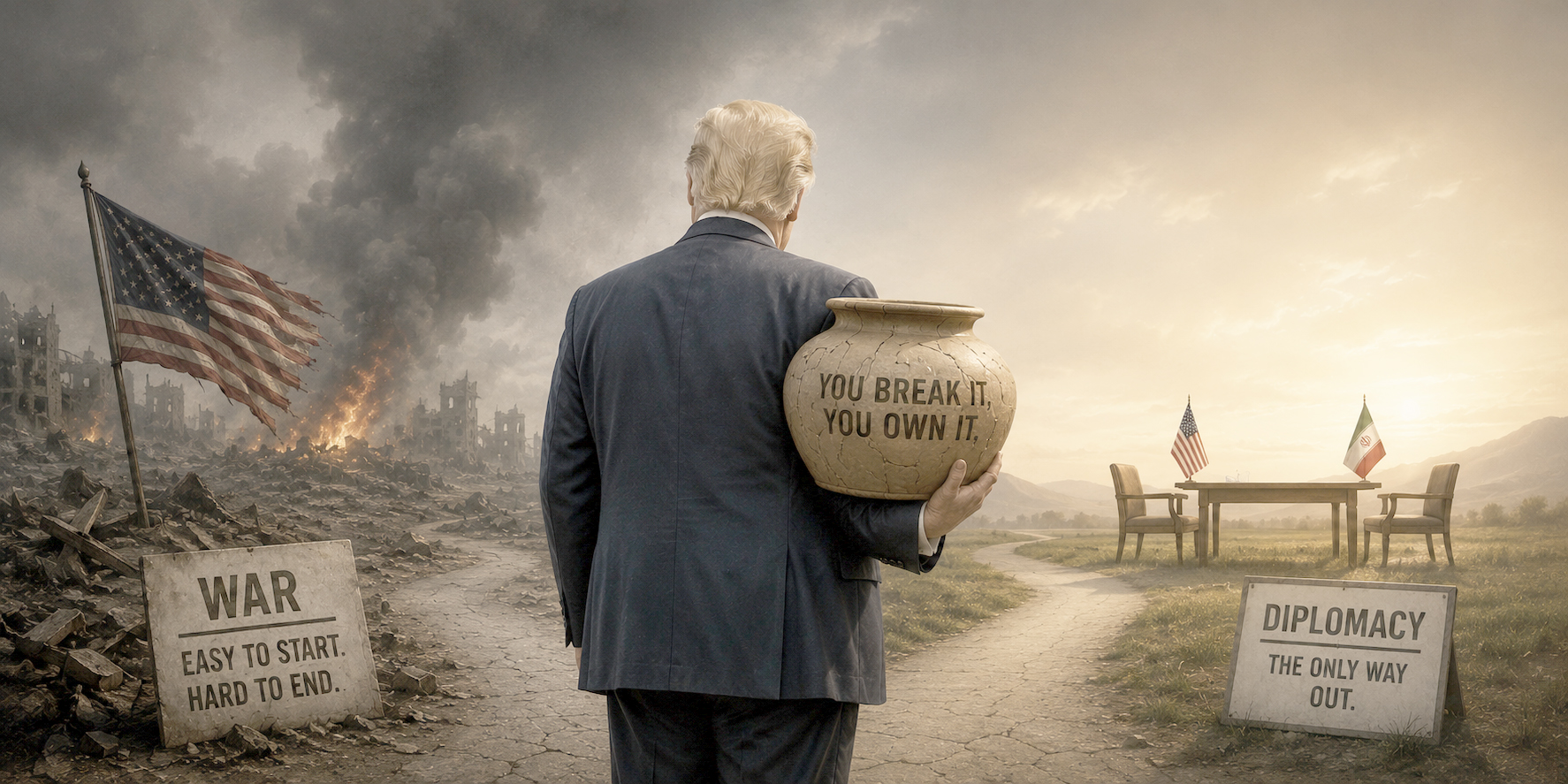
When Donald Trump wrote onTruth Socialthat any agreement with Iran must be “great and meaningful,” or there would be no agreement at all, he appeared to be drawing a wall between himself and Barack Obama’s nuclear deal. He wanted to make clear that even if negotiations were underway, they would be Trumpian negotiations: tougher, more forceful, and the “exact opposite” of an agreement he had spent years denouncing as a symbol of weakness. But that statement revealed less strength than contradiction. A president who once treated Obama’s diplomacy with Iran as appeasement now has to sell his own diplomacy as victory.
The issue is not how different Trump’s possible agreement would be from the JCPOA. The issue is why things reached the point where a president elected on an America First platform dragged the United States into a crisis from which he now needs the very tool he once called weakness: diplomacy. Trump was not supposed to pull America into other people’s wars. A large part of his political appeal was built on that promise: ending endless wars, not repeating the same road under new packaging. Yet the Iran war showed that even a president who came to power under the banner of America First can quickly fall into the same pit as his predecessors when he is trapped by Washington’s old logic, lobby pressure, neoconservative temptation, and Israel’s security agenda.
Exactly who placed what on Trump’s table behind closed doors cannot be proven with certainty until some members of his administration begin to speak openly. But politics is not made only behind closed doors. Outside those rooms, the signs are clear enough: hawkish senators, anti-Iran media commentators, figures close to pro-Israel networks, and the remnants of a worldview that sees every Middle Eastern crisis as an opportunity to display American power. We may not be able to say with certainty who pulled the trigger inside the administration’s mind, but we can see who helped create a political atmosphere in which any retreat from war looks like a betrayal of victory.
Ted Cruz’s behavioris a clear example of this pattern. The terms of a possible agreement have not even been made clear, yet he is already speaking of “deep concern,” as if the real issue were not the text of the agreement but Trump’s attempt to leave the path of war. Mark Levin and figures such as Laura Loomer reproduce the same psychological pressure through cheap media theatrics: either chase the enemy to some imaginary point of total defeat, or be accused of selling out victory. These are not merely political reactions; they are part of the same agenda-setting process trying to claim Trump’s movement for itself.
But the reality is simpler and more bitter. America entered a confrontation it had no vital need to enter directly. War with Iran was supposed to be a show of resolve. It was supposed to prove that Trump, unlike Obama and Biden, was not interested in appeasement. But now that same war has become a test of exit. Striking was easy; explaining the consequences is harder. Slogans were easy; managing energy markets, theStrait of Hormuz, allied reactions, divisions inside the Republican Party, and the political cost of continuing the crisis is not.
This is why Trump’s recent Truth Social post matters. He wants to say that his possible agreement with Iran will not be Obama’s agreement. He says that if there is to be a deal, it must be “great and meaningful.” But the central question is not how the text of his agreement would differ from the JCPOA. The central question is this: why does a president who treated Obama’s negotiations with Iran as weakness now need negotiations of his own to manage a crisis intensified by a military decision?
Trump wants to register the war as strength and the negotiations as victory. But foreign policy is not that generous. In the Middle East, whoever opens the door to crisis sooner or later owns the consequences. This is the famousPottery Barn ruleof American foreign policy: You break it, you own it. Trump wanted the military strike, but not ownership of the crisis. He wanted distance from the JCPOA, but now he faces the same truth: no major crisis ends with bombs alone. Eventually, someone has to return to the negotiating table.
The irony is that Trump, better than anyone, should have known this road. Did Obama’s mistakes during the Arab Spring not show that intervention in regional crises often produces new disorder instead of a new order? Did the Biden-Harris approach to Ukraine and endless support for foreign wars not show how the White House can become a spending office for taxpayers’ money in the name of other people’s security? So why did an administration that was supposed to move beyond this logic place itself back on the same pothole-ridden road?
This crisis is not only about Iran. It is about whether Trump’s movement can truly break from Washington’s old logic or whether it will ultimately be swallowed by the same forces that are always ready to drag any president into a new war in the name of security, freedom, deterrence, or defending allies. Today, that same network is telling Trump that if he fights, he is a strong leader; if he negotiates, he must prove he has not sold out victory.
But Trump has to decide whether he is the president of America First or the executive manager of someone else’s agenda. Negotiating with Iran is not inherently a defeat. The defeat comes when you first enter an unnecessary war and then have to sell negotiation not as rational statecraft, but as victory.
Source: Antiwar.com
