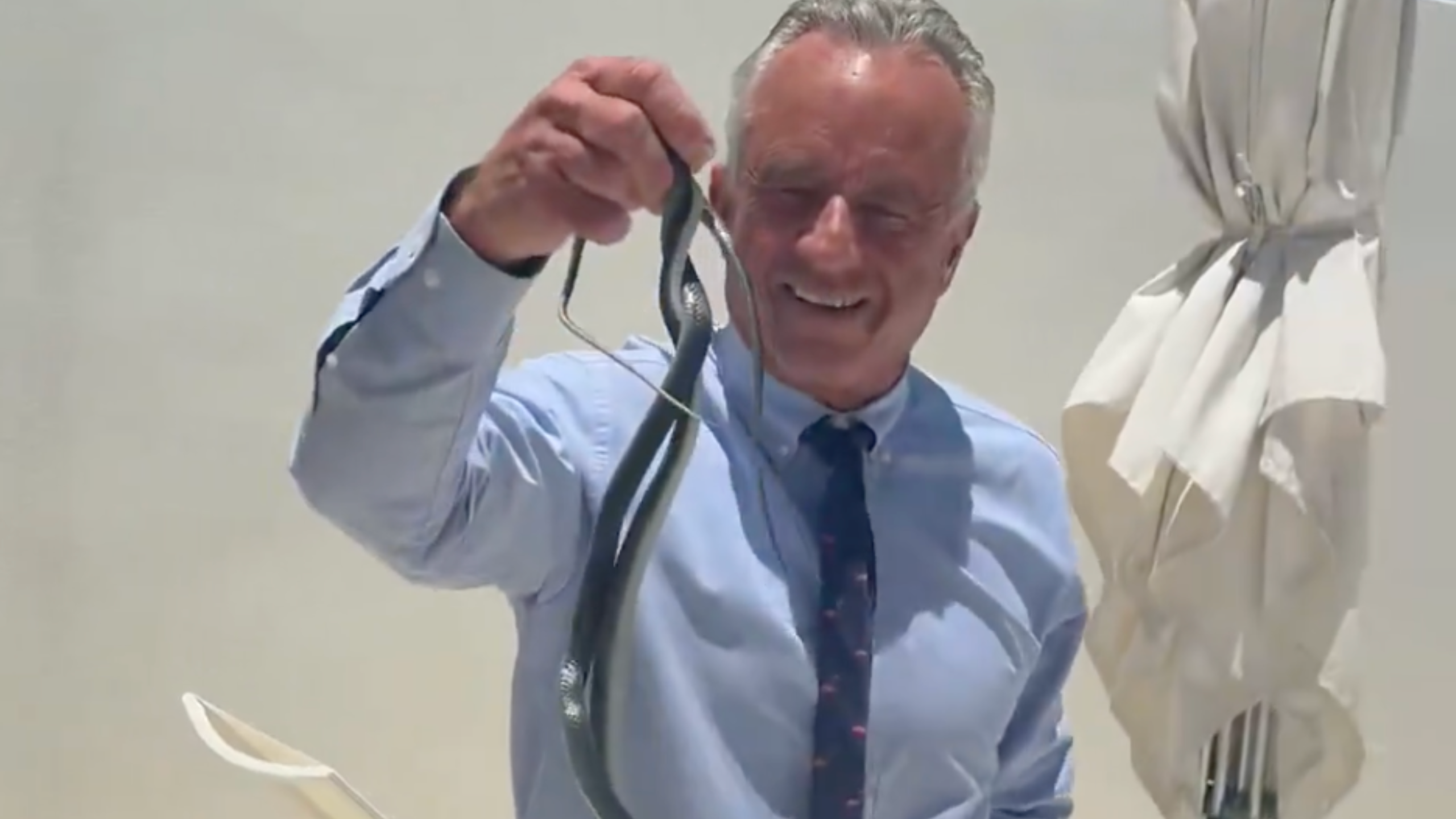
The US Health Secretary grabbed two mating wild snakes with his bare hands, got bitten, and sparked a debate over species identification, all while his wife pleaded for him to stop.
Robert F. Kennedy Jr., the United States Secretary of Health and Human Services, uploaded a video to X on 26 May 2026 that swiftly went viral, not for its policy implications, but for its sheer spectacle: the 72-year-old cabinet member crouching barefoot on a beachside patio in West Palm Beach, Florida, seizing two large wild snakes in his bare hands as his wife, actress Cheryl Hines, begged him to let them go. The clip, filmed at the Florida mansion of Centres for Medicare and Medicaid Services Administrator Dr Mehmet Oz, immediately prompted questions online about precisely what species Kennedy had grabbed, and just how dangerous they actually were.
Kennedy captioned the post, 'Cheryl cheerleads the removal of a pair of Black Racers from Dr Oz's patio.' But it was the audio, more than the caption, that captured public attention
In the footage, Hines is heard repeatedly exclaiming 'Bobby, why?' as Kennedy attempted to snatch the two black snakes cornered on a section of Oz's patio. 'They were having sex. So what were they?' a voice off camera asks, after Kennedy successfully nabbed the wriggling creatures.
As the snakes clamped down on Kennedy, Hines shouted 'Moccasins. Those are dangerous!' Kennedy calmly replied, 'No, they're not moccasins', correctly, as Black Racers are non-venomous.
Kennedy held the snakes up for the camera with a grin as they continued to twist and turn. It took him eight seconds to grab both, and one of the snakes bit him on the finger. 'Honey, honey, let it go,' Hines pleaded at the precise moment the snake struck. 'Oh my God! Bobby, Bobby, please!' Kennedy looked at his finger but did not appear fazed in the slightest.
Cheryl cheerleads the removal of a pair of Black Racers from Dr Oz's patio.pic.twitter.com/A0iiRzOeIF
The species at the centre of the commotion is theSouthern Black Racer(Coluber constrictor priapus), one of the most common snakes in Florida. The southern black racer is native to the southeastern United States and is widely found across Florida, Georgia, Tennessee, Alabama, Louisiana, and South Carolina.
Critically, black racer snakes are non-venomous. They are considered timid by nature and are mostly harmless if not attacked or threatened, though they can and do bite in self-defence when cornered. While black racer bites are non-venomous, they can still hurt and, as with any animal bite, carry a risk of infection.
The confusion that Hines voiced, mistaking the Black Racer for a cottonmouth, or water moccasin, is a surprisingly common error. The cottonmouth, known scientifically asAgkistrodon piscivorus, is a dark-bodied, aquatic, thick-set snake with vertical pupils and is highly venomous. It is a species that Black Racers are sometimes mistaken for in low light. The two species are not closely related, and an experienced handler would distinguish them readily, though to an untrained eye, a large, dark snake moving quickly in a corner could understandably cause alarm.
Source: International Business Times UK
