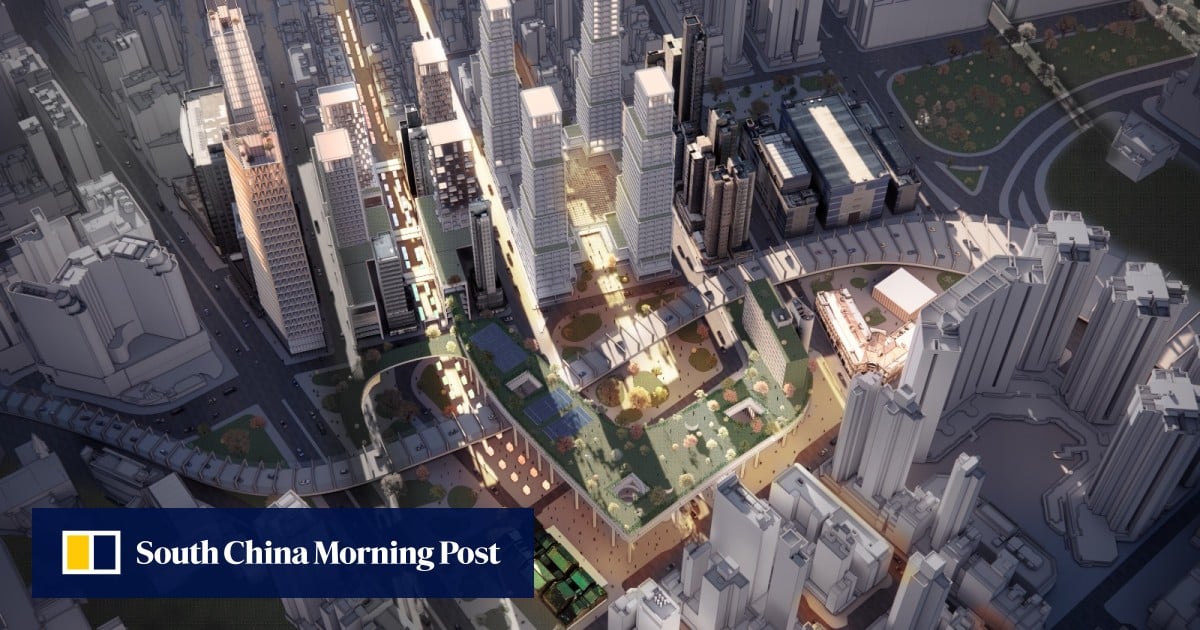
A young professional architectural and urban design team shows that redevelopment and preserving local character need not be in conflict. In fact, redevelopment can serve as the enabler and facilitator.
[The content of this article has been produced by our advertising partner.]
In Yau Ma Tei, street life, wet markets, night-time food stalls, small workshops and informal gathering spaces are tightly interwoven, giving the district its distinctive character and strong sense of place.
A young cross-disciplinary team with background in architecture and urban planning believes this vibrant fabric can be strengthened through holistic urban renewal.
Their proposal, “Heartbeat of the City, Voices of the Streets”, is centred around the proposed “Cultural Belt”/ Civic Node in Yau Ma Tei, as part of the Urban Renewal Authority (URA) and Hong Kong Institute of Architects (HKIA) Urban Renewal Design Ideas Competition for the District Study for Yau Ma Tei and Mong Kok (YMDS). The competition asked teams to demonstrate how the study’s new planning tools could be applied to two real-world sites, one around the Central Urban Park in Mong Kok, and the other around the Heritage Park in Yau Ma Tei, as proposed in the YMDS.
The team, comprising Ar. Cheung Hoi Lan (Sandy Cheung), Ar. Chan Wang Fung (Raphael Chan), Chen Lok Ching (Vanessa Chen), Chung Yin and Cheng Chun Hei (Alex Cheng), developed a clear “3Cs” principle —Culture, Connectivity, and Communal—to underpin their work.
The Cultural principle celebrates the vibrant, diverse and inclusive nature of Hong Kong’s local culture. With walkability in mind, the Connectivity principle focuses on the pedestrian experience in order to sustain street vibrancy and improve movement throughout the district.
This thinking is most visible in their approach to Connectivity. Adopting a creative reinterpretation of the proposed multi-storey “Civic Node” in the YMDS, the proposal introduces a continuous green deck that stitches together fragmented plots and roadways, enabling multi-level circulation. At the same time, strong visual and physical connections to the ground-level streets are carefully maintained.
Paradoxically, while creating more open space, the team also believes that density is treated as part of Yau Ma Tei’s cultural identity. “Yau Ma Tei is already dense,” notes team member Vanessa Chen. “The narrow gaps between buildings and tightly knit street blocks create a sense of intensity that defines the district. If the urban fabric becomes too loose, the area would no longer feel like Yau Ma Tei—it would lose the character people recognise,” Chung Yin adds.
In their proposal, the 3Cs—Culture, Connectivity, and Communal—are articulated through the integrated application of TPR and SCA. Development potential within the proposed Cultural Belt/Civic Node area is transferred to other sites earmarked for higher-density development, thereby releasing ground-level space for public enjoyment (Communal) while enabling the construction of the multi-level green deck to improve walkability and circulation across the district (Connectivity). SCA is further applied to sites along Shanghai Street to create a generous ground-level space for a new “Wok Lab”, a communal food-focused hub that brings together a wet market, culinary craftsmanship, cooking classes, and workshops, exemplifying both the Communal and Culture principles.
Source: News - South China Morning Post
