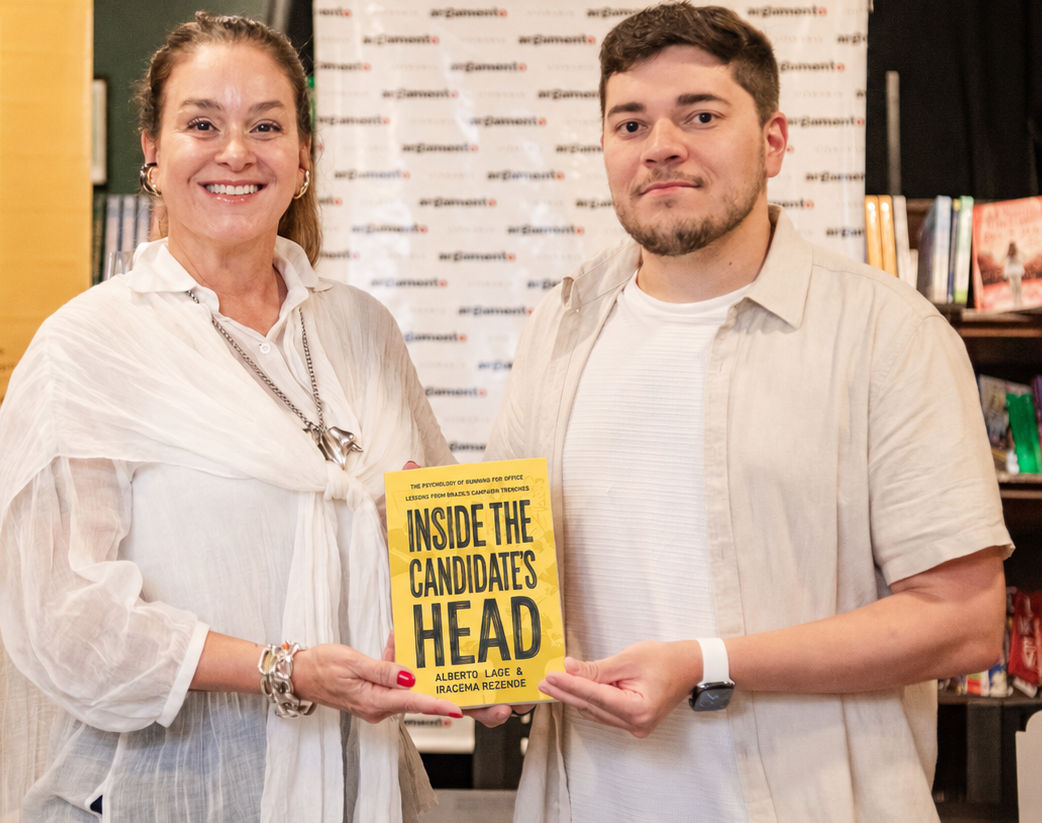
London, United Kingdom —Following its rise on Amazon Brazil's bestseller lists and the expansion of its Spanish-language edition across Latin America and Spain, 'Inside the Candidate's Head: The Psychology of Running for Office - Lessons from Brazil's Campaign Trenches' is now available worldwide in English.
The book is co-authored by Brazilian political strategist Alberto Lage and psychologist Iracema Rezende. Originally released in Portuguese in September 2025 as 'Cabeça de Candidato', the title quickly reached the top of Amazon Brazil rankings in Elections, Politics, and Social Sciences. The English edition is now available globally in Kindle, paperback, and hardcover formats through Amazon and the official website atinsidethecandidateshead.com.
The international rollout follows the publication of the Spanish edition, 'Cabeza de Candidato: Dentro de la mente del poder | Lecciones de campañas en Brasil', translated by Marcus Vinicius Baldo, co-founder of Compol Brasil. The Brazilian edition includes a preface by political scientist Felipe Nunes, while the translated versions include a foreword signed by Paulo Carlos López-López, Professor of Political Science at the University of Santiago de Compostela and spokesperson for Sumar Galicia, part of Spain's governing coalition.
Rather than centering its analysis on polling, messaging, or electoral data, the book examines the psychological conditions surrounding candidates and campaign teams during moments of extreme pressure.
Drawing from years of political consulting and behavioral analysis, Lage and Rezende focus on the emotional dynamics that often remain invisible in public discussions about elections. Fear, ego, insecurity, overconfidence, and the inability to confront uncomfortable realities emerge as recurring forces influencing leadership decisions.
The authors argue that many campaign failures are not caused by flawed technical strategy alone, but by the emotional environments in which decisions are made. Temporary structures built around urgency and power disputes can create distorted communication, defensive behavior, and strategic blindness.
This perspective moves the book away from the format of a conventional campaign manual. Instead, it approaches elections as human systems shaped by stress, hierarchy, and psychological tension.
Although the case studies are rooted in Brazil's electoral environment, the English edition positions the book within a broader international conversation about leadership under pressure, thanks to consultants Pam Spencer and Lynn White, both of whom have recognized careers in organizational culture in the British context, and encouraged the English-language release, including this perspective. The consultants are mentioned in the acknowledgments of the translated version of the book.
Its themes extend beyond politics into corporate management, institutional leadership, nonprofits, startups, and organizations facing high-stakes decision-making. The dynamics described by the authors, such as pressure cultures, low psychological safety, communication breakdowns, and concentration of power, are presented as universal organizational patterns.
The release arrives at a moment of growing international interest in Brazilian political communication. Brazil's campaign environment has increasingly drawn attention across Latin America due to its scale, volatility, and intensity, becoming a reference point for consultants and analysts studying electoral behavior in emerging democracies.
Source: International Business Times UK
