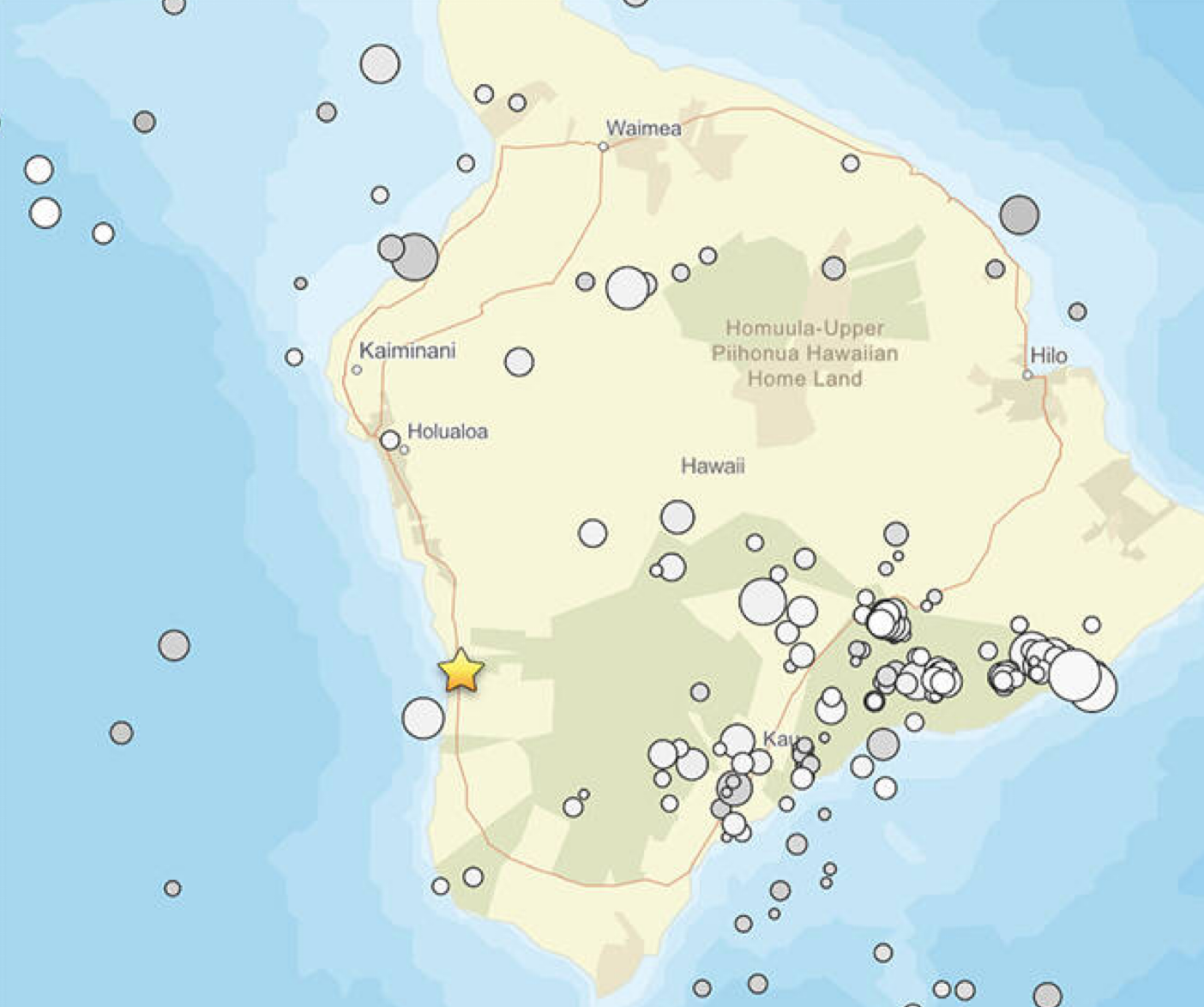
A magnitude 6.0 earthquake struck the western flank of Mauna Loa on Hawaii's Big Island on Friday night, but officials said there was no eruption of Mauna Loa andno tsunami warningin effect after the quake.
The US Geological Survey (USGS) reported that the tremor hit at 9:46 p.m. local time, shaking communities across the state yet sparing the islands from the kind of cascading disaster many residents instinctively fear.
Mauna Loa is the largest active volcano on Earth and last erupted in late 2022, sending lava flows down its slopes and briefly raising global attention on Hawaii's volcanic risks.
Any sizeable earthquake beneath or near the mountain tends to trigger immediate speculation about whether magma is on the move or a tsunami might follow. Authorities moved quickly on Friday night to shut down those rumours and focus on what was actually happening on the ground.
The quake was centred about 7 miles south of Honaunau-Napoopoo and 22 miles south-southeast of Kailua-Kona, at a depth of roughly 14 miles, according to USGS data. It was originally logged as magnitude 5.9 but upgraded to 6.0 after further analysis, a modest revision that can nonetheless change how engineers and emergency planners rate the event.
The Hawaii Police Department said large rocks and debris tumbled onto Napoopoo Road as the ground shook, prompting officers to close both lanes between the 10-mile marker and Middle Keei Road.
The closure allowed crews to work through the night clearing the route, a familiar dance in a region where steep slopes and narrow roads leave little margin when rocks start moving.
The Pacific Tsunami Warning Center confirmed that the earthquake did not generate a tsunami. Some coastal areas still experienced strong shaking, but the feared wall of water never materialised. That distinction matters in Hawaii, where tsunami sirens and evacuation routes are imprinted on local memory.
USGS scientists were blunt in their assessment of any link between the quake and Mauna Loa's volcanic systems. 'The earthquake had no apparent impact on either Mauna Loa or Kilauea volcanoes,' they said in a statement, adding that the event was not a sign of imminent eruption.
Instead, seismologists traced the cause to the slow, grinding physics of the Pacific plate under the islands. 'The depth, location, and recorded seismic waves of the earthquake suggest that it was caused by stress due to bending of the oceanic plate from the weight of the Hawaiian island chain; the earthquake was not directly related to volcanic processes,' the statement continued.
Source: International Business Times UK
