Freddie Ponton21st Century Wire
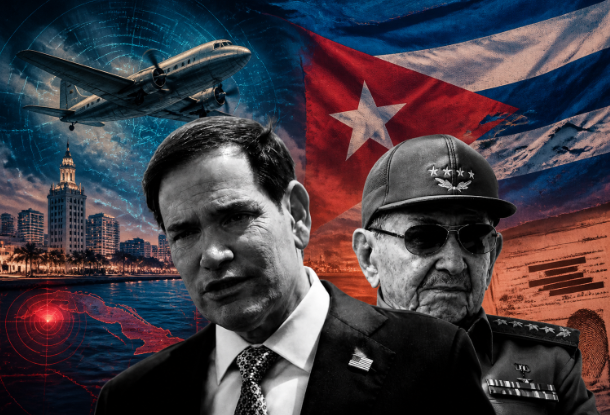
Washington has revived one of the most combustible episodes inU.S.-Cuba relationsjust as Cuba buckles underblackouts, fuel shortages and intensified economic strangulation. On May 20, 2026, theJustice Departmentunsealed murder-related charges against 95-year-old former Cuban presidentRaúl Castroand five other Cuban officials over the 1996Brothers to the Rescueshootdown, then chose to announce them at Miami’sFreedom Tower, before a room of hardline exile activists who greeted the case as political vindication rather than legal procedure.
IMAGE: Cuba’s President Raúl Castro listens to the Cuban and Venezuelan national anthems during his welcome ceremony at the Miraflores presidential palace, March 17, 2015, in Caracas, Venezuela. (Source: AP Photo/Ariana Cubillos)
OnFebruary 24, 1996, three small planes flown by the Miami-based exile group Brothers to the Rescue took off from Opa-Locka airport on what the group presented as a mission near Cuban waters. Two of the aircraft were later destroyed by Cuban MiG fighters, killing four crew members, including threeU.S. citizens. Cuba said it was defending its airspace, while U.S. officials and the victims’ families argued that the planes were ininternational airspacewhen they were hit. TheInternational Civil Aviation Organizationcondemned the shootdown, and the episode became one of the defining flashpoints in the long standoff between Havana and Washington.
One day earlier, theNational Security Archive, the independent research center at George Washington University that uses declassification and Freedom of Information requests to reconstruct buried state history, published a new batch ofFAA recordson the shootdown and its lead-up, explicitly noting that the release came on the eve of the indictment. Those records do not read like a simple murder file. They show U.S. officials warning, long before the MiGs took off, that Brothers to the Rescue’s flights had turned into “taunting” incursions and that Cuba might eventually shoot one of the planes down.
A 30-year-old tragedy is being repackaged as moral clarity just as Washington tightens the screws on an island already in profound distress. The same documents being cited to support the indictment also expose something far more awkward for the U.S. government. Officials in Washington saw the danger coming, understood that Brothers to the Rescue was provoking a violent confrontation, and failed to stop it.
Freedom Tower was the natural stage for that conversion of history into pressure politics. It is one of the symbolic temples ofexile, Miami, the city where anti-Castro militancy, lobbying money and U.S.-Cuba policy have fed off one another for decades. By the timeTodd Blancheread out the charges, the case had already been turned from a disputed historical tragedy into a live instrument of the current campaign to keep Cuba isolated, criminalized and under siege.
The most revealing paper in the National Security Archive’s May 19 release of declassified FAA records is not dramatic in form. It is a shortemailsent on January 22, 1996 byCecilia Capestany, an FAA International Affairs official. Writing after yet another unauthorized Brothers to the Rescue flight, and relaying a State Department alarm, Capestany described the incursion as “further taunting of the Cuban Government.” She then wrote the line that now sits at the center of the story:
“Worst case scenario is that one of these days the Cubans will shoot down one of these planes and the FAA better have all its ducks in a row.”
Capestany’s email also shows how far concern had spread inside theClinton administration.Peter Tarnoff,Bill Clinton’s undersecretary of state for political affairs, had called Transportation SecretaryFederico Peñato ask what was being done aboutJosé Basulto, the Brothers to the Rescue founder whose flights had been repeatedly challenging Cuban airspace. By January 1996, this had already reached the Cabinet. The government knew Basulto was escalating a dangerous confrontation. It knew Cuba was reacting with growing anger. It still failed to shut the operation down.
Source: 21st Century Wire
