Home-UltiMaker Launches Factor 4 Plus for Industrial and Defense 3D Printing
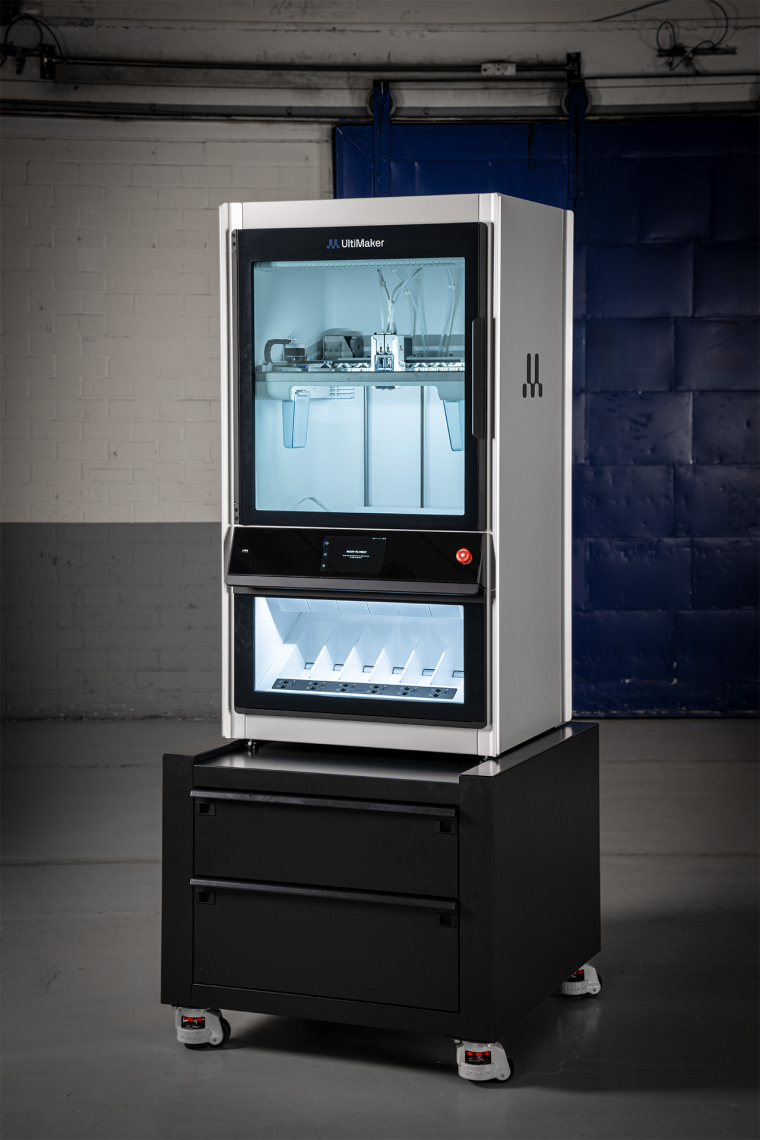
UltiMaker, a manufacturer of desktop and industrial 3D printing systems recently, launched theFactor 4 Plus, a new industrial platform designed for continuous production in manufacturing and defense. Built as a faster version of the standard Factor 4, the new system delivers up to twice the print speed and targets applications including custom jigs, fixtures, and durable spare parts. Material support includes PPS-CF, a composite formulated for high-heat and chemically demanding environments.
The firm paired that hardware with TRACE, short for Technical Reporting And Certification Engine, a system that automatically validates each print. TRACE records print data directly from the machine to generate a validation report, giving users a documented record for quality assurance in end-use production. In manufacturing settings, that reporting is intended to support consistent standards across repeated builds.
“When I talk directly with our customers, one message comes through consistently: speed is great, but proving the quality of the part is the real challenge,” said Arjen Dirks, Chief Technology Officer at the 3D printing company. “TRACE was built directly in response to that feedback and I’ve seen firsthand what an incredible improvement it makes. Pulling validation data straight from the hardware gives customers the confidence and traceability they need to scale additive manufacturing into true production environments.”
Defense deployment shaped another part of the redesign. Factor 4 Plus uses a new gantry architecture built to absorb vibration at high print speeds, helping maintain precision during continuous operation in harsh or remote environments. In field settings, TRACE records parameters including extrusion behavior and chamber temperature, then produces a CAD-validation report that can be reviewed immediately to support rapid part deployment and verify that components meet mission-ready requirements. UltiMaker also describes the platform as self-contained and designed for operation with minimal training in temporary or forward field sites.
Speed improvements come fromUltiMaker’s Cheetah motion plannerand compatibility with new AA+ and CC+ high-flow print cores. Cheetah reduces abrupt motion changes that can introduce vibration, allowing higher throughput while preserving dimensional accuracy. UltiMaker states that this combination improves performance across materials including PLA, ABS, and PPS-CF.
UltiMaker expands a broader defense manufacturing strategy
UltiMaker alreadystarted building a defense-focused product linebefore introducing the Factor 4 Plus. Last year, the Dutch 3D printing manufacturer launched its Secure Line, including the S6 Secure and S8 Secure, for high-security and defense environments. Those systems were designed around air-gapped, USB-only workflows, tamper-resistant firmware, encrypted file handling, and hardware-sealed components for deployment across mobile units, military bases, and naval settings. That earlier release established security and field deployment as central requirements in UltiMaker’s defense offering, not secondary features.
Defense also become a largercommercial and operational target for the company. UltiMaker stated that it expects defense to account for around 30% of total revenue by the end of 2026, driven by demand for field-ready FDM systems, open materials access, and NATO-aligned data security. That strategy reflects a specific constraint in military additive manufacturing: buyers need systems that can produce parts across distributed sites while maintaining repeatability, traceability, and sourcing flexibility. Factor 4 Plus fits into that shift by adding higher throughput and print-validation tools to a product line already moving toward secure, deployable production.
3D Printing Industry is inviting speakers for its 2026 Additive Manufacturing Applications (AMA) series, covering Energy, Healthcare, Automotive and Mobility, Aerospace, Space and Defense, and Software. Each online event focuses on real production deployments, qualification, and supply chain integration. Practitioners interested in contributing cancomplete the call for speakers form here.
Source: 3D Printing Industry
