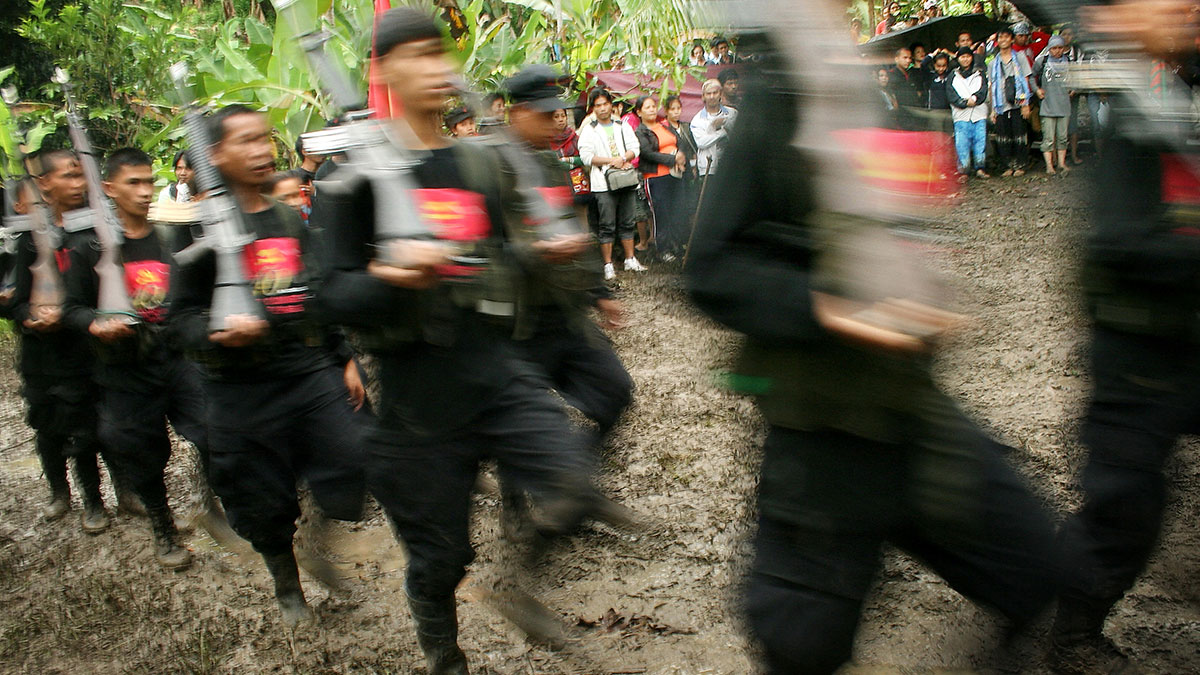
Campus networks and diaspora groups groomed two citizens for radical violence that led to their deaths.
Photo by STR/AFP via Getty Images
Last month, two Americans were killed in a foreign state’s counterterrorism operation. If Lyle Prijoles, 40, and Kai Dana-Rene Sorem, 26, had been part of a group of jihadi terrorists in the Middle East, their deaths would likely have generated national headlines. But they were in the Philippines, fighting for the New People’s Army (NPA), a decades-old Maoist insurgent group that serves as the armed wing of theCommunist Party of the Philippines(CPP).
The two appear to have died fighting: many Western reports of the incident explicitly note that Prijoles’s and Sorem’s deaths occurred in a “firefight,” implying an exchange of fire between both sides. Nor were they fighting on the side of good: both the CPP and NPAare designatedforeign terrorist organizations by the State Department.
Finally, a reason to check your email.
How did two Americans die in a gun battle on behalf of Filipino Communist terrorists? The incident shows how Americans can becomemixed upwith terrorist organizations. Such entanglements begin not just overseas but also within political organizing environments in the United States, including college campuses and diaspora advocacy networks. Both the U.S. government and higher education institutions should scrutinize these networks more closely—before more American lives are lost.
Prijoles and Sorem’s radicalization began with two left-wing activist groups: Anakbayan-USA and Bayan-USA. Both operate within segments of the Filipino-American community in the U.S.
The Philippine government haslong arguedthat such groups are fronts for the CPP. Through these groups, Filipino Communist influence has extended into segments of the Americananti-imperialistandabolitionistorganizing space. The party and its aligned networks have also been visible in the anti-Israel protest movement, according to areportby the Center for Security Policy.
Prijoles appears to have been radicalized at San Francisco State University sometime around 2004, eventuallyserving aschair of SFSU’s chapter of the League of Filipino Students. After his death, his wifetold a local news outletthat “his passion for the community grew while he was a student at SF State.” Prijolesmade several tripsto the Philippines after 2006, andwas a leaderin the U.S. chapter of the International Coalition for Human Rights in the Philippines.
This activity made him a natural fit for Anakbayan. In 2012, Anakbayan-USA held its Founding Congress; Prijoleswas elected“Solidarity Officer.” After that, his organizing work took on an increasinglyinternational character, and he grew more and more active on the ground in the Philippines.
Source: Drudge Report
