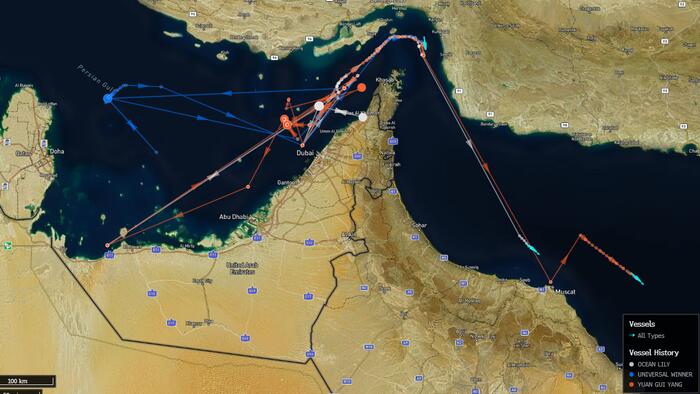
Three commercial supertankers carrying a combined 6 million barrels of Middle East crude oil havesuccessfully exitedthe Strait of Hormuz, according to Reuters.
The vessels departed the strategic waterway on Wednesday, after being stranded inside the Persian Gulf for over two months, lending hope to an end to the closure of the strait.
The crude cargoes were split evenly among three Very Large Crude Carriers (VLCCs) heading to Asian refining hubs.The first was Universal Winner, a South Korean-flagged supertanker carrying 2 million barrels of Kuwaiti crude oil. Shipping data on LSEG and Kpler showed that the vessel is currently en route to Ulsan, South Korea, to discharge at an SK Energy facility by June 9.
The second VLCC was Yuan Gui Yang, a Chinese-flagged vessel hauling 2 million barrels of Iraqi Basrah crude. Chartered by Unipec (the trading arm of Sinopec), the supertanker is heading toward Guangdong province with an expected arrival on June 4.
Finally there wasOcean Lily, a Hong Kong-flagged tanker loaded with 2 million barrels split evenly between Qatari al-Shaheen and Iraqi Basrah crude.Owned by Sinochem, the vessel is tracking toward Fujian province for a June 5 arrival.
Combined,the trio have about 6 million barrels of crude on board— one of the biggest oil flows in a single 24 hour period in over a month.
All three vessels switched off their digital transponders before exiting. Two have since transited the strait and were sighted near Oman while the status of the third is unclear. It also remains to be seen if they all can get past a seaparte US blockade. The supertanker heading to South Korea, the Universal Winner, is the first observed sailing by a VLCC to the Asian country since the war began.
Iran's state TV underscored that the country now appears to be in sole control over who crosses the strait and who doesn't.“Today other countries like South Korea, taking their example from the Chinese, coordinated with the IRGC navy and arranged the passage of their ships through the Strait of Hormuz,”the TV correspondent says in report from near the strait. “Coordination increased today and it’s expected to increase further tomorrow”
The correspondent said he witnessed five oil supertankers passing the strait with IRGC coordination, without giving further details
Meanwhile, following the footsteps of China and South Korea, India is preparing to send its own vessels through the Strait of Hormuz to load up energy cargoes from suppliers in the Middle East, Bloomberg reported; it would be the first time since the Iran conflict began that the country will do so.
Source: ZeroHedge News
