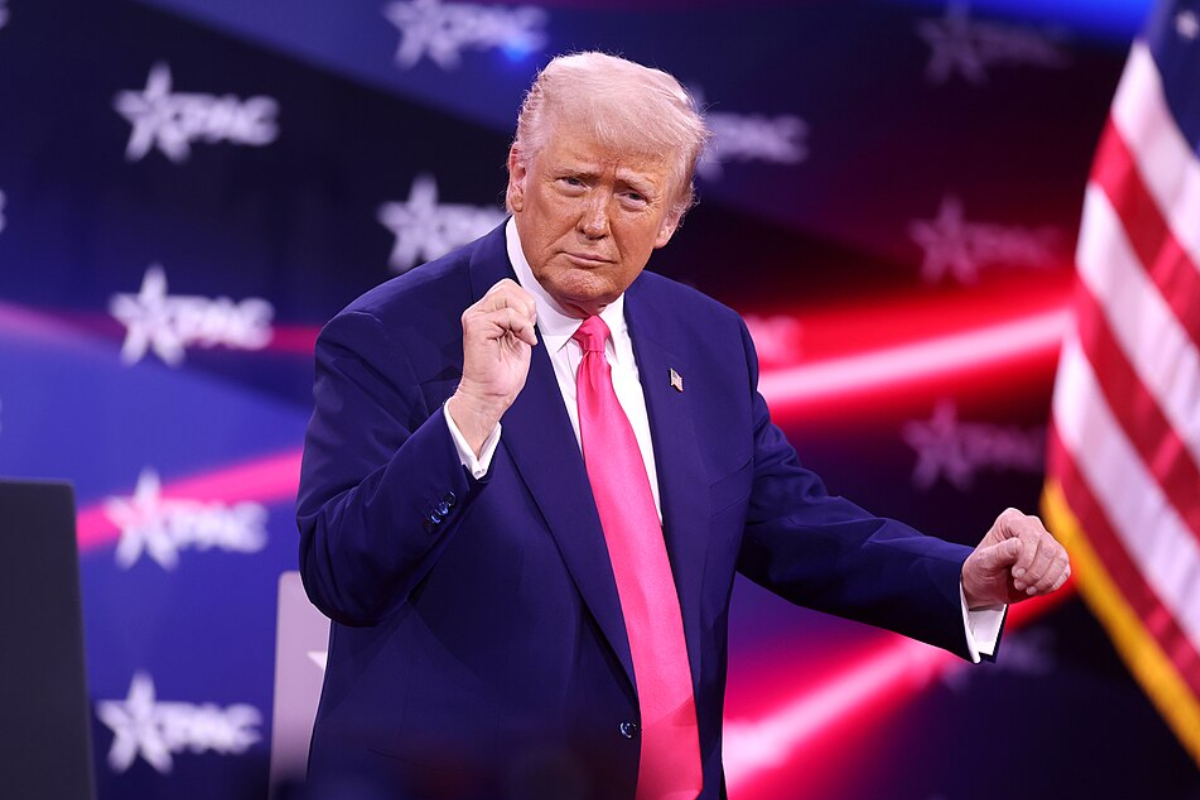
President Donald Trumpsecured sweeping protection from past and future tax audits in Washington on Tuesday, after a little-noticed settlement document signed by Acting Attorney General Todd Blanche declared the Internal Revenue Service 'forever barred' from pursuing him, his family or their businesses over unpaid taxes.
The amnesty forms part of the deal that ended Trump's $10 billion lawsuit against the US government but was revealed only after the Justice Department publicly touted a separate $1.776 billion 'anti-weaponisation' fund linked to the same settlement.
The unusual arrangement grew out of Trump's decision earlier this year to sue his own government over the leak of his tax returns and other financial records by a contractor in 2019 and 2020. That lawsuit pitted the sitting president against the federal agencies he controlled, creating an extraordinary conflict in which his administration effectively negotiated with itself over how much money would be paid out and what legal protections he would receive.
I pay my taxes.You pay YOUR taxes.If we don't pay our taxes, its simple: You get fined, or you go to jail.Unless you name is trump: He, and his family, were somehow just given blanket pardons for any and all tax crimes -- past, present or future.THIS IS A HUGE SCANDAL.pic.twitter.com/fdANxTedWB
The news came after the Justice Department on Monday released a nine-page document laying out the terms of the $1.776 billion fund, billed as a remedy for government 'weaponization' and designed, according to officials, to compensate those harmed by misuse of confidential tax information. That lengthy outline was the centrepiece of a formal press release, which made no mention of any special tax treatment for Trump or his family.
Only on Tuesday did a separate, single-page instrument quietly appear, carrying Blanche's signature and spelling out what critics are now calling tax amnesty. The wording is blunt. The IRS is 'FOREVER BARRED and PRECLUDED' from prosecuting or even 'examining' Trump, his sons Don Jr. and Eric, assorted 'affiliated individuals,' and a web of related trusts and companies, for any tax returns filed before the agreement took effect.
The Daily Beast, which first reported the existence of the document, said it had asked the Justice Department why this provision was disclosed separately and a day later than the fund details. At the time of publication, there was no public explanation as to why such a major concession to the president was effectively buried.
What stands out is who signed what. The nine-page fund agreement bore the signatures of the IRS commissioner and the associate attorney general, suggesting institutional buy-in. The tax shield for Trump and his business empire carried only Blanche's name. Before stepping in as acting attorney general, Blanchehad servedas Trump's personal criminal defence lawyer. Whether that dual role is merely awkward or legally untenable is already a matter of fierce dispute in Washington.
On Capitol Hill, senators spent much of Tuesday grilling Blanche over the 'anti-weaponization' fund, apparently unaware that a parallel tax guarantee for Trump was already on the books. Blanche repeatedly insisted that there were precedents for such compensation schemes, pointing to an Obama-era programme for black farmers. Democratic lawmakers countered that in that case a federal judge had approved the settlement and that it had not sprung from a president suing his own administration.
Once news of the tax amnesty filtered through, the reaction from senior Democrats was scathing. Senate Finance Committee ranking member Ron Wyden accused the Justice Department of stretching its settlement to the point of unlawfully interfering in IRS oversight of the president's finances.
Source: International Business Times UK
