Authored by Lance Roberts via RealInvestmentAdvice.com,
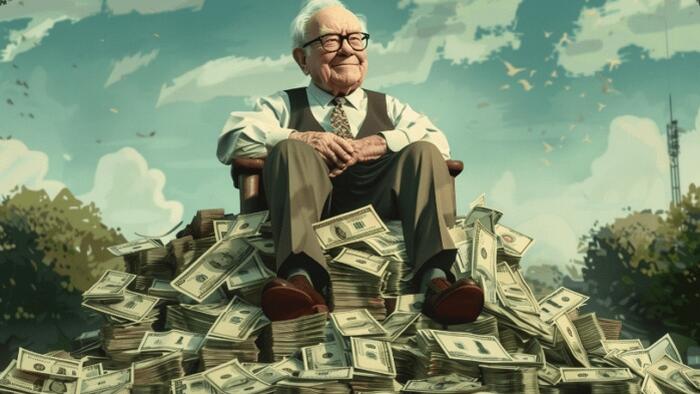
$397 billion.That’s how much “Buffett cash” now sits on Berkshire Hathaway’s balance sheet after Greg Abel’s first quarter as CEO. Warren Buffett left $373 billion behind when he stepped down at the end of 2025. Three months later, after Abel’s debut earnings report on Saturday, the hoard had grown by another $24 billion. The figure is bigger than the GDP of Hong Kong or Norway. It exceeds the market value of every American corporation except a tiny handful of mega-cap names. And it earned roughly four to five percent in Treasury bills while the S&P 500 ripped through three of its best consecutive years in modern history.
That Buffett cash hoard has also created a lot of speculation, innuendo, and assumptions, which is what I want to walk through in today’s discussion. Primarily, what that cash hoard actually represents, the popular theories explaining it, and what it really costs shareholders to hold.
The headline cash hoard number is striking on its own. Berkshire Hathaway ended Q1 2026 with a record $397.4 billion in cash and short-term Treasury bills, surpassing the prior $381.7 billion peak set in Q3 2025 and adding another $24 billion to what Buffett left behind. Of that, roughly $52 billion sits in plain cash and equivalents, with the bulk parked in Treasury bills earning short-term yields. By the time Abel released his first quarterly print on May 2, Berkshire was one of the largest holders of US Treasury debt in the world.
This wasn’t an accident. Between 2022 and 2024, Berkshire sold a net $172.93 billion in equities, with $134.1 billion of that coming in 2024 alone. Buffett trimmed his Apple position from nearly 50% of the equity portfolio down to roughly 22%. He cut Bank of America by more than half. Berkshire stopped repurchasing its own shares for nearly two years, sitting out twenty-one consecutive months as the stock traded above what Buffett considered its intrinsic value. Buybacks finally resumed under Abel on March 4, 2026, but only at $234 million in Q1, a token figure against a balance sheet of this size. In Q1 alone, Berkshire sold another $24.1 billion in equities against $16 billion in purchases, a net $8.1 billion reduction that pushed the cash pile to its new record.
The selling was deliberate, sustained, and almost entirely contrary to the prevailing market mood. While CNBC anchors debated whether the AI revolution was just getting started, the world’s most patient investor was quietly heading for the exits. Abel, in his first quarter, did exactly the same thing.
Berkshire’s cash position has always been countercyclical. When markets get cheap, the pile shrinks. When markets get expensive, it grows. That pattern has held for decades, but the magnitude in this cycle is unlike anything we’ve seen before.
In 2014, Berkshire’s cash and Treasury position hovered around $63 billion. By 2019, it had grown to $128 billion as bull market valuations stretched higher. The pandemic crash in early 2020 drew Buffett out for a brief window, when he deployed capital into Occidental Petroleum and Chevron. Those deployments barely dented the larger trend, and by the end of 2022, Buffett’s cash hoard had only modestly receded to roughly $109 billion despite the bear market that year.
Then came 2023 and 2024. As the S&P 500 ripped through gains of roughly 26 percent and 25 percent in consecutive years, Buffett didn’t chase. He sold. The cash hoard nearly doubled in 2024 alone, climbing from $168 billion to over $325 billion. By Q3 2025, it crested at $381.7 billion before a slight deployment trimmed it to $373.3 billion at year-end. Then in Abel’s first quarter at the helm, the hoard climbed to a fresh record of $397.4 billion as Berkshire kept selling, kept compounding T-bill yield, and continued to find few large-scale opportunities at acceptable prices.
The shape of that chart isn’t a coincidence. It’s the visual representation of a value investor’s discipline meeting a market that increasingly didn’t offer value. And the bar that matters most now is the one on the right: the discipline didn’t end with Buffett’s retirement.
Source: ZeroHedge News
