Freddie Ponton21st Century Wire
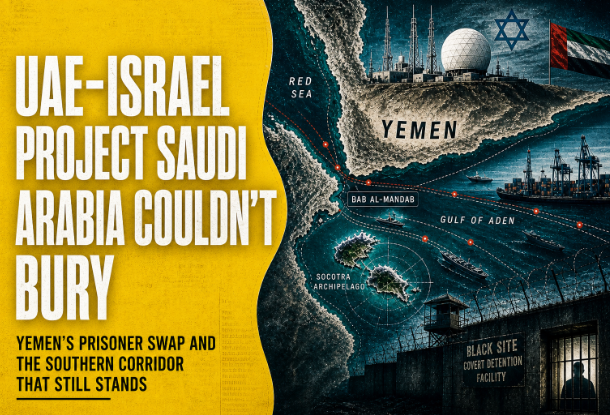
Behind aUN-backed prisoner exchangebetween Yemen’s internationally recognised government and theHouthislies a deeper story of islands, radar, black sites, and a southern Yemen security order Riyadh chose to dismantle after years of coalition decay. This proxy network stretching from Yemen’s Socotra Island to Bosaso on Somalia’s coast, across the maritime corridor between the Red Sea and the Horn of Africa, was built on torture, constant sea surveillance and coalition infighting, only to be sold to the world by Western navies as “freedom of navigation.”
After January 2026, we were told that this decade-long tripartite between the UAE, Israel, and the Yemeni separatist Southern Transitional Council (STC) had been dismantled. But how much of that machinery still stands, under new flags and quieter names, waiting for the next round? Since January 2026, the noise has been about “dissolving” the STC and managing Saudi–UAE friction, but what almost no one has asked is whether the UAE–Israel island pact, its radars, runways and black‑site prisons strung along Yemen’s southern waters, ever stopped operating, or just slipped under friendlier flags.
Riyadh’s strike on the STC shattered a larger Red Sea order
On 14 May 2026, negotiators for Yemen’s Presidential Leadership Council and Ansarallah signedthe country’s largest prisoner exchange since the war began, agreeing in Amman to swap more than 1,600 detainees under UN auspices. Saudi Arabia helped facilitate the deal behind the scenes, while the Emirati-backed Southern Transitional Council stayed out of sight and the UAE had no formal role at the table, even though some of the war’s most notorious detention networks grew out of the southern security order they built together. For families searching prisons, camps, and unofficial detention sites, the agreement offered a rare opening in a war that turned disappearance into routine.
IMAGE: Yemeni gov’t, Houthis strike deal on largest prisoner exchange (Source: Bastille Post)
The deal also cast light on how much the balance inside the anti-Houthi camp has shifted since the start of 2026. Riyadh now speaks through thePresidential Leadership Council,the STC has been broken in name, and Abu Dhabi’s southern instrument no longer appears openly in the diplomacy, even though its legacy still shapes the coast, the islands, and the coercive structures left behind. The timing of the swap, coming weeks after Houthi missile launches toward Israel and amid a wider regional escalation, gives Riyadh a way to cool one front withAnsarallahwhile the region may slide toward a broader war that its own past interventions helped stoke.
When Saudi Arabia moved in January 2026 todismantle the Southern Transitional Council (STC), it was doing far more than disciplining a troublesome Yemeni ally. It was tearing into asouthern security orderthe UAE had spent years building through proxy forces, island facilities, surveillance infrastructure, and political patronage across one of the most sensitive maritime corridors in the world. That order had already begun to intersect withIsrael’s post-Abraham Accords security agenda in the Red Sea and Gulf of Aden, while on the ground it rested on a coercive system of detention and torture thatrights groups, UN investigators, and Yemeni activists have traced to UAE-backed and STC-linked forces.
To understand why the Saudi move carried such weight, it helps to begin with the shape of the Yemen war itself. Ansarallah consolidated control over most of the north after taking Sanaa in 2014 and forcing the Saudi-backed government from the capital, while theSaudi-led coalition entered the war in 2015, claiming it would restore that government and roll back Houthi gains. Yet the coalition always contained rival projects: Saudi Arabia sought a formally unified Yemeni state that would secure its border, while the UAE built power in the south through local militias and parallel institutions that answered less to Yemen’s government than to Abu Dhabi’s strategic vision.
By late 2025, the STC had pushed that project further than Riyadh was willing to tolerate. On 2 December 2025, STC forces opened a rapid offensive across southern Yemen (Code name:Operation Promising Future), rolling into key districts of Hadramawt while tightening their hold over Aden and long stretches of the southern coastline.The pushbrought STC units intodirect confrontationwith the Presidential Leadership Council (PLC) local allies and triggered ashutdown of PetroMasilawhen fighters deployed around the company’s facilities, underlining how far the STC was prepared to go in using territory and resources to rewrite the balance of power in the south.
Source: 21st Century Wire
