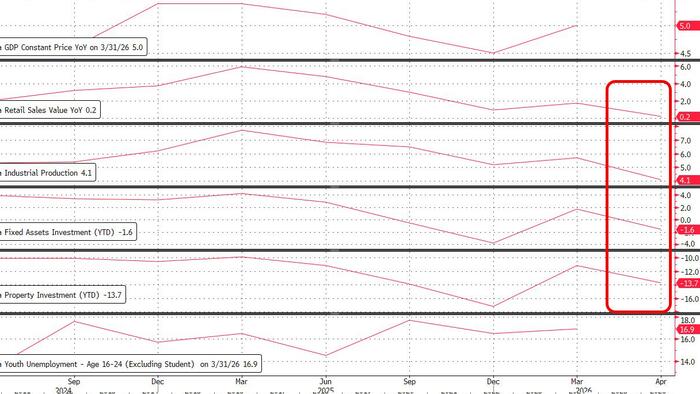
Confirming ourSunday preview, overnight China reported growth data which slowedacross the board in Aprilwith investment resuming declines, retail sales missing sales and growing at the weakest rate in 4 years while industrial production rose at the slowest pace in three years, calling into question Beijing's reluctance to add stimulus to the economy as a global energy crisis hits factories and consumers across the world.
China's Monday data dump of official data on Monday painted a picture of an economywhere booming exports no longer offset deteriorating consumption at home,prompting analysts at banks including Nomura and SocGen to urge bolder measures in support of growth.
As shown in the chart below,fixed-asset investment unexpectedly shrank 1.6% in the first four months of 2026 from a year earlier,while industrial production grew just 4.1% last month,the weakest in almost three years.Retail sales also missed forecasts and rose just 0.2% in April,the worst reading since they contracted in December 2022, when China reopened from Covid.
What is shocking is that it is common knowledge that Beijing traditionally massages its economic data to present itself in the rosiest possible light: the fact that it allowed data this ugly would suggest that the picture on the ground is much uglier.
Goldman's Delta One head Rich Privorotsky captured this sentiment well, writing this morning that "overnight news from China showed economic data materially below expectations. Industrial production, retail sales and fixed asset investment all missed meaningfully.It’s hard to tell whether this reflects genuine demand destruction but perhaps it helps explain how the oil market has managed to balance despite ongoing supply concerns.I genuinely can’t remember a period when Chinese data, which tends to be heavily massaged, missed by anything close to this magnitude.Negative read through for consumption related categories."
Remarkably,not a single economist surveyed by Bloomberg had predicted as pessimistic a reading for industry,retail sales and investment. The disappointing performance of the world’s second-biggest economy last month is a reminder of its domestic vulnerabilities, after a global artificial intelligence investment boom sent trade soaring.
The breadth of the acute slowdown in April has put the prospect of a more aggressive stimulus back on the agenda after China stood out in its resilience to the fallout from the Iran war. The government pulled back on fiscal spending in March, while the central bank has steered clear of even hinting at any further loosening in policy, amid ample market liquidity and weak demand for credit.
Fu Linghui, spokesman for the National Bureau of Statistics, described the deterioration of economic indicators as “a normal fluctuation from month to month.”But he also highlighted challenges such as a persistent imbalance between supply and demand as well as a complex global environment.
Investment plunged by around 8% in April from a year earlier, according to estimates from Goldman Sachs and Capital Economics, returning to a similar pace of decline seen in the second half of 2025. Manufacturing and infrastructure investment both weakened, while private investment plummeted
In response to the dismal data, Nomura economists wrote that authorities “might need to step up policy support for stabilizing growth,” adding that “Beijing has no room for complacency.”
Source: ZeroHedge News
