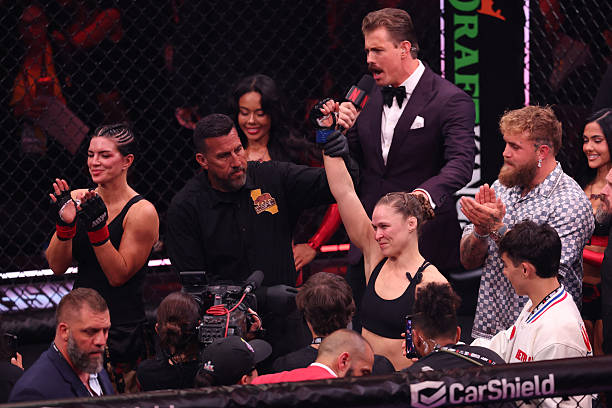
This weekend saw the return of two notorious women mixed martial artists to competition, Ronda Rousey and Gina Carano, with Rousey earning a round one 17-secondarmbarfinish during the Most Valuable Promotions debut MMA event.
Before their rise, women’s mixed martial arts existed mostly on the margins of the sport, scattered across regional promotions, often overlooked and frequently questioned as a legitimate part of MMA’s future. Today, that landscape looks completely different. Women headline major UFC cards, produce world champions across multiple divisions and compete in a sport that no longer treats their presence as an exception.
While both Rousey and Carano have been trailblazers for the sport, their legacies are defined by what they achieved inside the cage. And they are defined by what came after: how women’s MMA grew beyond its early limitations and what it has become in the years since. But that shift makes more sense when you look at where women’s MMA began.
Before women’s MMA entered the UFC mainstream, it existed in smaller, fragmented promotions such as Strikeforce, which was later purchased by the UFC in 2011, and EliteXC, which went bankrupt in 2008 before its roster and assets were absorbed by Strikeforce.
One of the first women to achieve mainstream visibility was Carano. Her Strikeforce bout againstCris Cyborgfor the featherweight title in 2009 marked the first time a major MMA promotion featured a women’s fight as a main event. While Carano came up short in that fight, it did not go unnoticed. Rousey took note of Carano’s success in Strikeforce and saw a path to build on that momentum.
Rousey, already well-versed incombat sports, won a gold medal for the United States in judo at the 2008 Olympic Games. Prior to the UFC’s acquisition of women’s MMA, she also became a dominant bantamweight champion in Strikeforce.
The UFC originally dismissed the idea of introducing a women’s division, citing a lack of depth in talent and limited interest in the sport. However, after signing Rousey in 2013, the UFC named her the first women’s bantamweight champion, officially establishing the division.
Then, in February 2013, UFC 157 marked Ronda Rousey’s first UFCappearance, where she defended her bantamweight championship against Liz Carmouche. Rousey came out on top, earning a submission victory via her signature armbar. With that win, women’s MMA firmly entered the mainstream conversation.
Rousey quickly became a household name, and the UFC marketed her as the next major star of the sport throughout the mid-2010s. She went on a five-fight winning streak from 2013 to 2015 before losing her bantamweight title toHolly Holmin November 2015. Her final UFC appearance came in December 2016, when she was defeated byAmanda Nunesin a first-round TKO.
Despite back-to-back losses at the end of her career and her eventual exit from the sport, Rousey’s legacy remained intact. Her rise between 2013 and 2015 helped accelerate the growth of women’s MMA, as the UFC expanded its women’s roster and built out new divisions.
Source: LowKickMMA.com
